
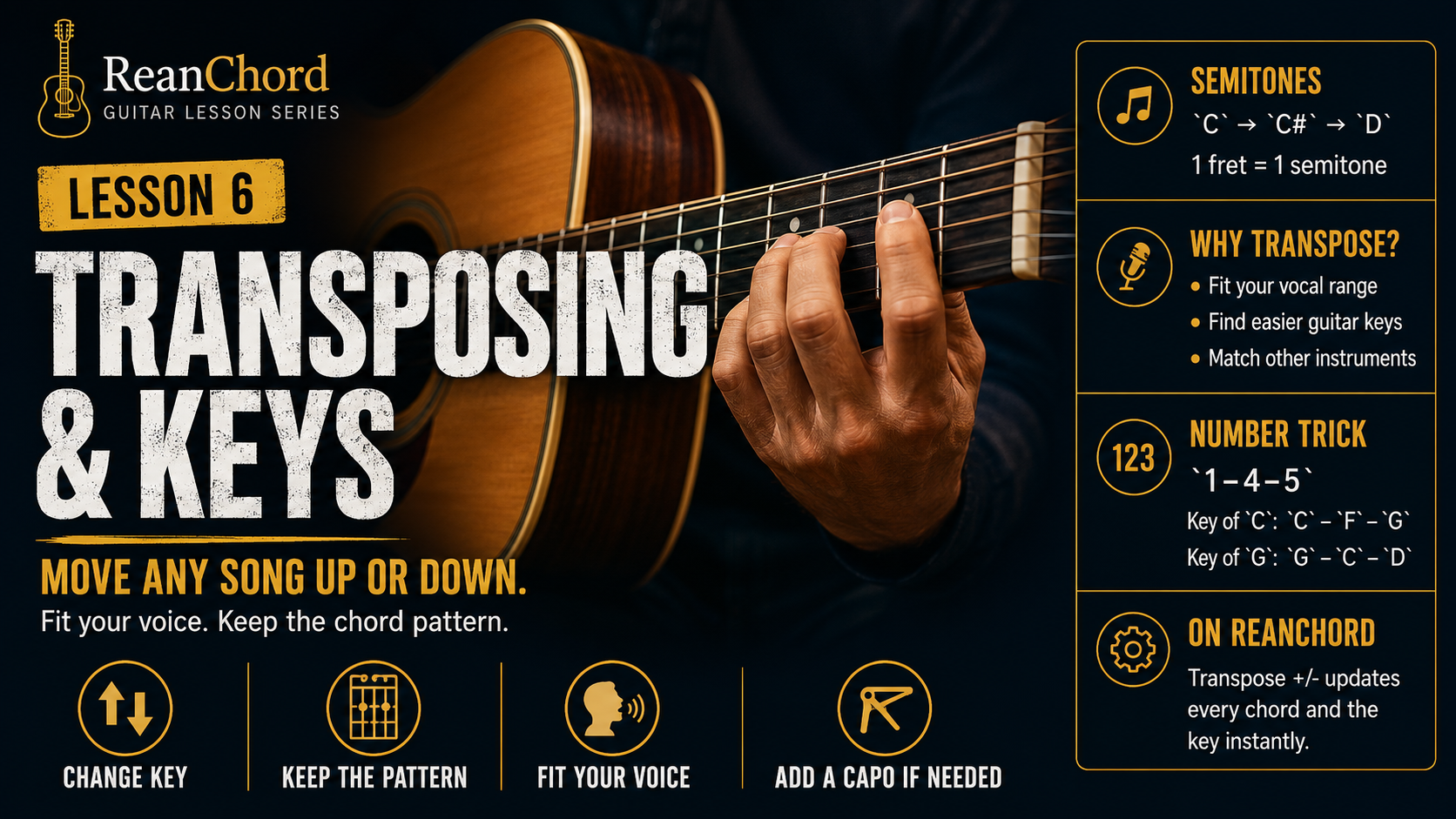
Intermediate · Transposing & Keys
Transposing moves an entire song higher or lower. Every chord shifts by the same number of semitones while its musical relationship stays unchanged.
Transposing helps fit a vocal range, simplify difficult keys, or match another instrument.
Chord-label rule: Every chord name in this lesson is marked like , , , , or .
1. What Is a Semitone?
A semitone is the smallest standard musical step. On guitar, moving one fret equals one semitone.
Examples moving upward:
→
→
→
Examples moving downward:
→
→
→
Two semitones equal one whole tone. Twelve semitones equal one octave.
2. The Chromatic Note Order
To transpose correctly, learn the order of all twelve notes:
– – – – – – – – – – – –
Some notes have two names:
=
=
=
=
=
These are enharmonic equivalents. They sound the same but may be written differently depending on the key.
There is no sharp or flat note between and , or between and . These pairs are already one semitone apart.
3. How Transposing Works
Suppose the original progression is:
– – –
Transpose every chord up two semitones:
→
→
→
→
The new progression is:
– – –
Every chord moved by the same amount, so the progression keeps the same musical character.
Downward Example
Start with:
– – –
Transpose down two semitones:
→
→
→
→
The result is:
– – –
4. Why Transpose a Song?
Fit Your Vocal Range
If the highest notes feel strained, move the song downward. If the melody feels too low, move it upward.
Choose a key where both the low and high notes feel comfortable.
Find Easier Guitar Chords
Beginner-friendly major keys often include:
, , , , and
These keys use many common open-chord shapes.
Match Other Instruments
A singer may request another key, a keyboard player may choose a different starting note, or a backing track may already be fixed in one key.
Transposing allows everyone to perform together.
5. Transposing on ReanChord
On a ReanChord song page, use the Transpose + and Transpose − controls.
Transpose Up
Press + to move every chord one semitone higher per step.
Original: – – –
+1: – – –
+2: – – –
Transpose Down
Press − to move every chord lower.
Original: – – –
−1: – – –
−2: – – –
ReanChord updates the Key label, every chord, slash chord, and extended chord automatically.
6. Guitar-Friendly Keys
Common beginner-friendly major keys are:
, , , , and
Their relative minor keys include:
, , , , and
Because , , and often require barre chords, beginners may prefer keys built around , , , , or .
Difficult-Key Example
A song in may contain:
– – –
Transpose it down one semitone to :
– – –
Alternatively, keep the true key of and use easier -family shapes with a capo on fret 3.
7. Transpose Versus Capo
Transpose
Transpose changes the true sounding key.
C major → D major
All chord names change.
Use Transpose when the song is too high, too low, or must match another instrument.
Capo
A capo changes the shapes you play while allowing the song to remain in the chosen sounding key.
True key:
Capo: fret 2
Shapes: – – –
Use a capo when the key is correct but the chord shapes are difficult.
Best Workflow
- Transpose until the song fits the voice.
- Check whether the new chords are comfortable.
- Add a capo when easier shapes are needed.
- Retune after attaching the capo.
8. The Number Trick
Chords can be understood by their position within a key.
In the key of C major:
1 =
2 =
3 =
4 =
5 =
6 =
7 = Bdim
The progression:
– –
can be written as:
1 – 4 – 5
In the key of G major:
1 =
4 =
5 =
The same 1–4–5 progression becomes:
– –
The chord names change, but the number relationship stays the same.
9. Common Number Progressions
1–4–5
Key of : – –
Key of : – –
Key of : – –
1–5–6–4
Key of : – – –
Key of : – – –
Key of : – – –
6–4–1–5
Key of : – – –
Key of : – – –
Thinking in numbers makes transposing easier because the complete pattern moves together.
10. Preserving Chord Quality
When transposing, keep the chord type the same.
up two semitones =
up two semitones =
up two semitones =
up two semitones = Esus4
The root note moves, but major, minor, seventh, and suspended qualities remain unchanged.
11. Transposing Slash Chords
Both parts of a slash chord move by the same amount.
up two semitones becomes .
The main chord moves from to , while the bass note moves from to .
Another example:
up two semitones =
ReanChord changes both parts automatically.
12. Common Mistakes
Avoid these habits:
- Moving only some chords
- Forgetting minor chords
- Ignoring slash-chord bass notes
- Confusing Transpose with Capo
- Choosing an easy key that does not fit the singer
- Forgetting that
B–CandE–Fare semitone pairs - Changing chord quality accidentally
- Transposing without checking the melody range
13. Practice Exercise
Start with:
– – –
Move up two semitones:
– – –
Move up five semitones:
– – –
Move down two semitones:
– – –
The progression remains 1–5–6–4.
14. Fifteen-Minute Practice Routine
Minutes 1–3
Say the chromatic notes forward and backward.
Minutes 4–6
Move four major chords up one semitone.
Minutes 7–9
Transpose – – – into the keys of and .
Minutes 10–12
Identify the 1–4–5 chords in , , and .
Minutes 13–15
Open a ReanChord song and test several Transpose settings. Choose the best key for your voice and playing ability.
Lesson Checklist
Before moving forward, make sure you can:
- Explain transposing
- Define a semitone
- Follow the chromatic note order
- Move every chord equally
- Use ReanChord’s Transpose controls
- Identify guitar-friendly keys
- Explain Transpose versus Capo
- Preserve chord quality
- Transpose slash chords
- Recognize number progressions
Encouragement
Transposing becomes easier when you see chords as connected patterns rather than isolated names.
A progression such as 1–5–6–4 keeps the same function in every key.
Transpose to fit the voice. Use a capo to simplify the shapes.
Next Lesson
Fingerpicking Basics
Next, you will learn how to assign fingers to strings, play simple picking patterns, keep a steady pulse, and turn ordinary progressions into flowing acoustic arrangements.