
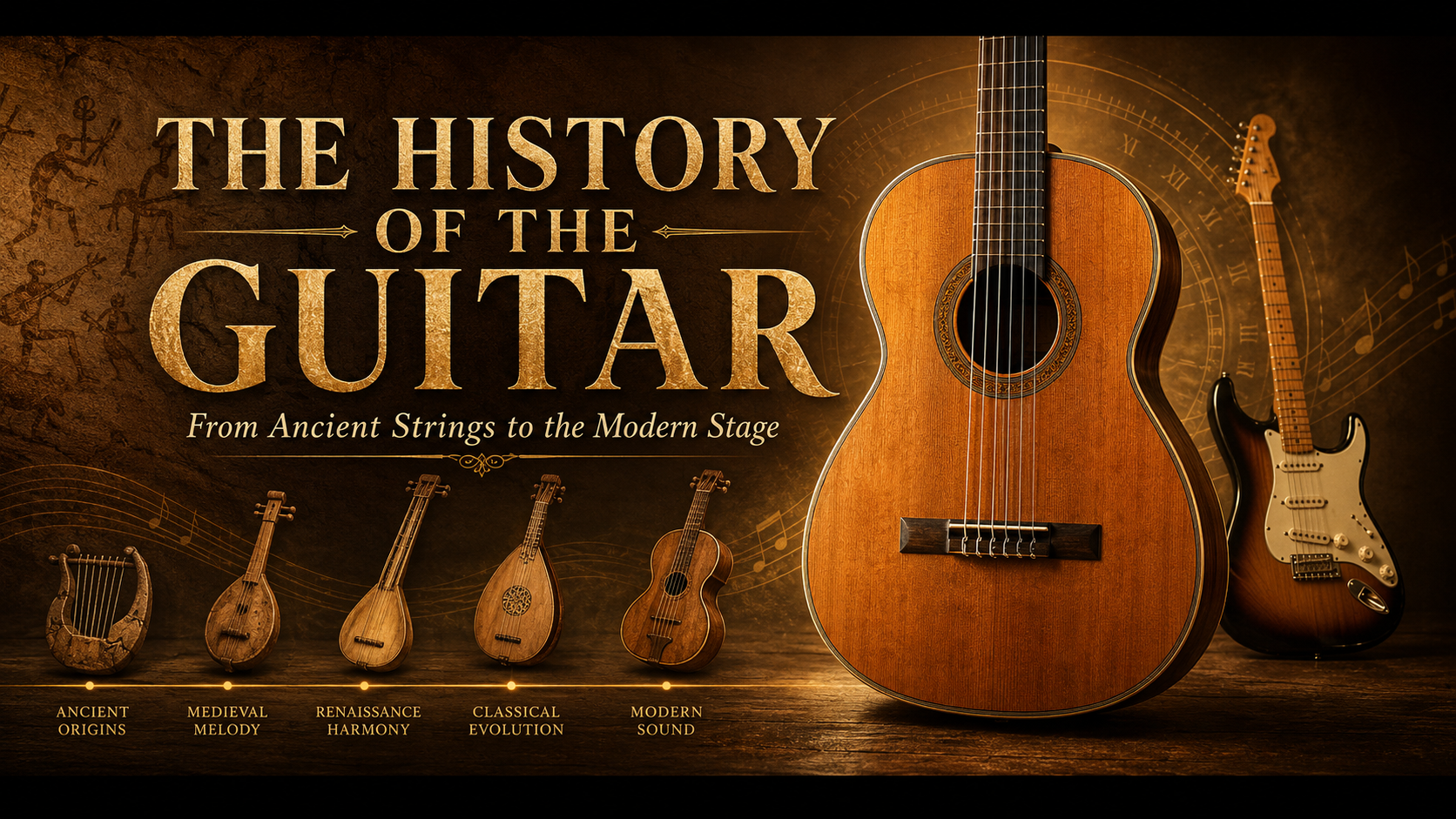
History of the Guitar
A Brief History of the Guitar: From Ancient Strings to the Modern Stage
The guitar is one of the world’s best-known instruments. It appears in folk, classical, rock, worship, pop, and home music.
Its familiar shape developed over centuries as builders changed the body, strings, tuning, and purpose. The modern guitar reflects centuries of exchange and craftsmanship.
Early Stringed Instruments
Long before the modern guitar, ancient cultures used harps, lutes, and other plucked instruments made from wood, skin, and hollow bodies.
Some had long necks, others rounded bodies, and many were played with the fingers or a pick.
These instruments were not modern guitars, but they established the same basic idea:
A vibrating string creates pitch, while a hollow body makes the sound louder.
Makers gradually experimented with string length, tuning, frets, and body shape.
The Oud and the Lute
Two important relatives were the Middle Eastern oud and the European lute.
The oud has a rounded body, short neck, and no frets. The lute developed with a similar back and often used frets during the medieval and Renaissance periods.
The guitar later developed a flatter body and a more direct neck-and-fret design, making it easier to hold and suitable for chord accompaniment.
Early Guitars in Spain
Spain played a major role in the guitar’s development.
Spanish musicians used several guitar-like instruments, including the vihuela and early guitarra.
These instruments helped establish the flat back, curved sides, fretted neck, and soundhole that later became central to guitar design.
The Baroque Guitar
During the seventeenth and early eighteenth centuries, the smaller Baroque guitar became popular in Europe. It usually had five courses, each containing one or two strings.
The instrument was used for:
- song accompaniment
- dance music
- court entertainment
- strumming
- solo pieces
Players used both strummed and plucked techniques, helping establish chord-based accompaniment.
The Six-String Guitar
By the late eighteenth and early nineteenth centuries, guitars moved from paired courses to six single strings.
The tuning became:
– – – – –
This tuning balanced bass, chords, scales, and melody.
The Classical Guitar
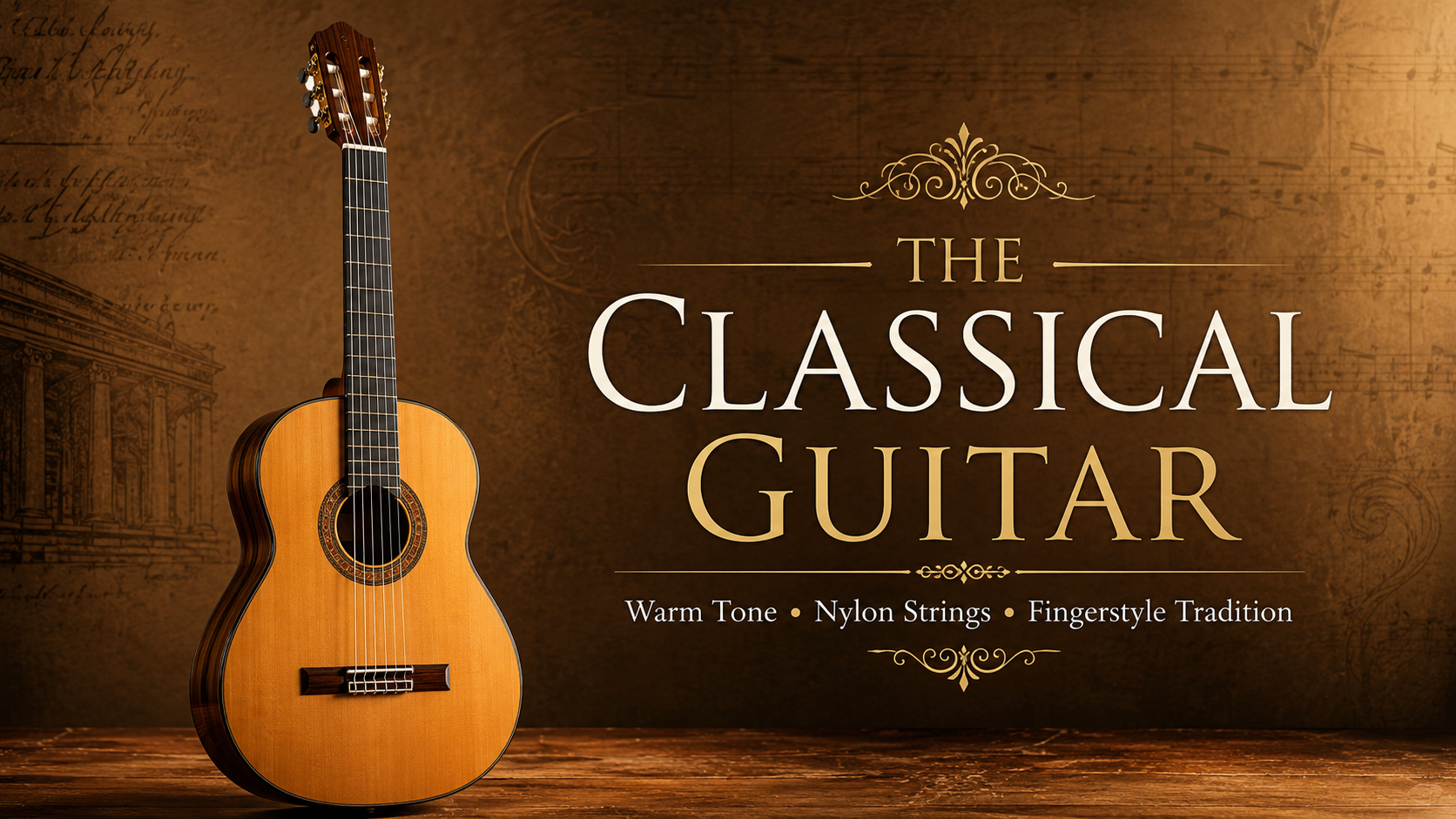
In the nineteenth century, Spanish guitar makers helped create the modern classical guitar.
One of the most influential builders was Antonio de Torres Jurado.
Torres enlarged the body and improved its internal bracing, producing more volume, fuller bass, clearer tone, and stronger projection.
Modern classical guitars usually use nylon strings, and the style emphasizes fingerpicking, tone control, and solo playing.
The Steel-String Acoustic Guitar
In the United States, makers developed louder guitars for steel strings, reinforcing the neck and body to handle the extra tension.
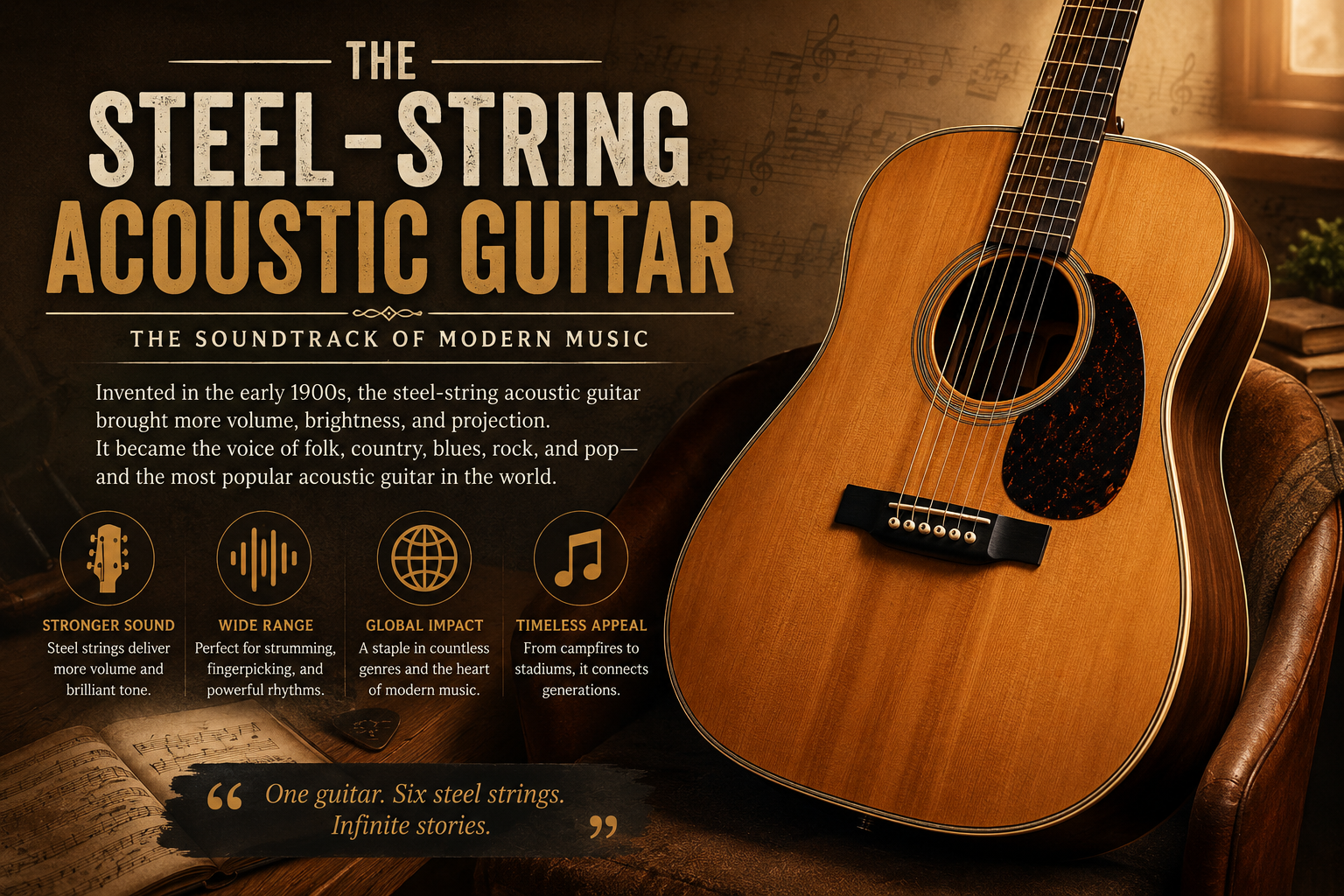
Companies such as Martin helped shape the modern acoustic guitar.
The steel-string guitar became important in:
- country
- blues
- folk
- bluegrass
- gospel
- singer-songwriter music
- modern acoustic pop
Its bright, strong tone worked for both rhythm and lead.
The Guitar in Blues and Folk Music
During the late nineteenth and early twentieth centuries, the guitar became central to blues, folk, and rural American music because it was portable and could accompany a singer alone.
Blues guitarists developed techniques such as:
- string bending
- slide playing
- alternating bass
- open tunings
- fingerpicking
- call-and-response phrases
These techniques later influenced rock, jazz, country, and global popular music. The guitar became a voice, not only accompaniment.
The Birth of the Electric Guitar
As bands became louder, musicians and engineers developed amplification so guitars could compete with drums and brass.
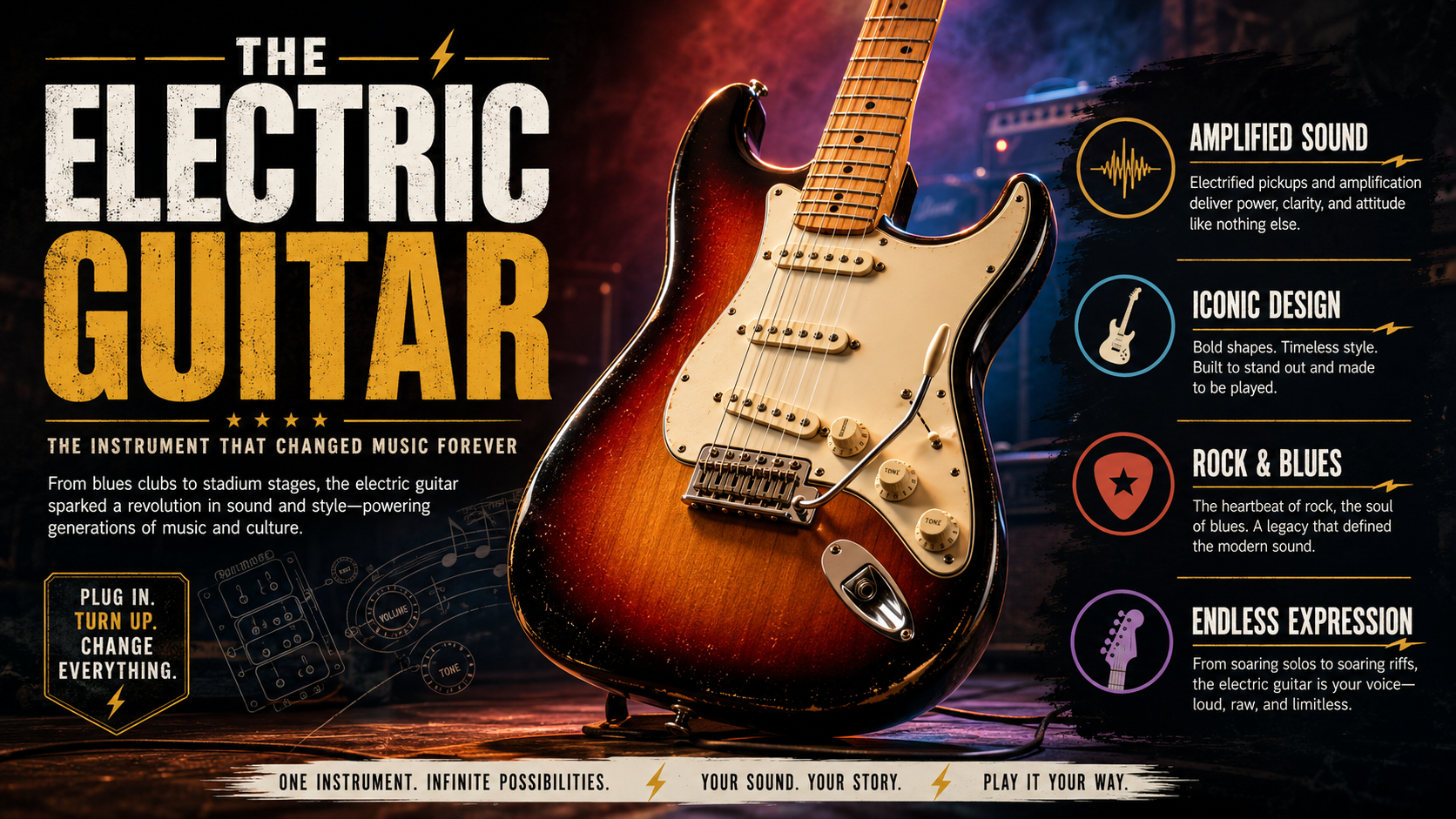
Early electric guitars used pickups to capture string vibration and send it to an amplifier.
By the 1930s and 1940s, amplified guitars appeared in jazz and swing. Solid-body designs later reduced feedback and allowed greater volume.
Designs associated with companies such as Fender and Gibson helped shape the modern electric guitar.
The Guitar and Rock and Roll
In the 1950s, the electric guitar became a defining sound of rock and roll.
Players used:
- strong rhythm patterns
- short solos
- string bending
- vibrato
- distortion
- power chords
During the 1960s and 1970s, effects, feedback, and louder amplifiers turned the guitar into a symbol of youth culture and artistic identity.
Rock, funk, soul, reggae, metal, and alternative styles all developed their own guitar sounds.
The Guitar in Cambodia
The guitar also became important in Cambodian popular music.
During Cambodia’s musical golden age, musicians blended Khmer melody with rock and roll, Latin rhythms, jazz, soul, and psychedelic music. Electric guitars appeared beside organs, brass, bass, and drums.
Artists such as Sin Sisamuth, Ros Serey Sothea, and Pen Ran performed songs shaped by this creative mixture.
The guitar helped Cambodian music sound modern and distinctly Khmer.
After the Khmer Rouge period, guitars remained important in refugee communities, the diaspora, weddings, karaoke, and modern recordings.
Acoustic and Electric Guitar Today
Today, the guitar exists in many forms:
- classical guitar
- steel-string acoustic guitar
- electric guitar
- hollow-body jazz guitar
- twelve-string guitar
- resonator guitar
- extended-range guitar
- travel guitar
- digital and MIDI guitar systems
Modern players can record at home, use software effects, share performances online, and learn from digital chord libraries. Yet the basic idea remains unchanged: vibrating strings shaped by the player’s hands.
Why the Guitar Became So Popular
The guitar became popular because it is versatile.
A beginner can accompany a song with a few chords, while an advanced player can perform classical music, jazz, fingerstyle, or technical solos. It is also highly portable.
The guitar can serve as:
- a rhythm instrument
- a lead instrument
- a solo instrument
- a songwriting tool
- a vocal accompaniment
- a cultural symbol
Few instruments move so easily between practice, family music, stage, and recording.
What Guitar History Teaches Players
The guitar’s history shows that instruments are never completely fixed.
Musicians and builders constantly adapt them.
New strings, body shapes, amplification, and effects continue to reshape the instrument. Every guitarist participates in that history.
When you change a chord shape, use a capo, create a fingerpicking pattern, or arrange a Khmer song, you are participating in the same tradition of experimentation.
A Simple Historical Timeline
- Ancient world: harps, lutes, and early plucked instruments appear across many cultures
- Medieval and Renaissance Europe: lute, vihuela, and early guitar-like instruments develop
- 1600s: Baroque guitar becomes popular
- Late 1700s–1800s: six single strings become standard
- 1800s: Spanish builders shape the modern classical guitar
- Late 1800s–early 1900s: steel-string acoustics grow in popularity
- 1930s–1950s: electric guitar develops
- 1950s–1970s: guitar becomes central to rock, pop, and Cambodian golden-age music
- Today: acoustic, electric, and digital guitars are used worldwide
Final Thoughts
The guitar developed through centuries of cultural exchange, craftsmanship, and musical need.
From ancient plucked instruments to Spanish classical guitars, American steel strings, electric rock guitars, and modern Khmer acoustic music, each stage added something new.
The next time you hold a guitar, remember that you are holding more than six strings and a wooden body.
You are holding history.
And every song you learn becomes part of what happens next.
— Written by the ReanChord team.