
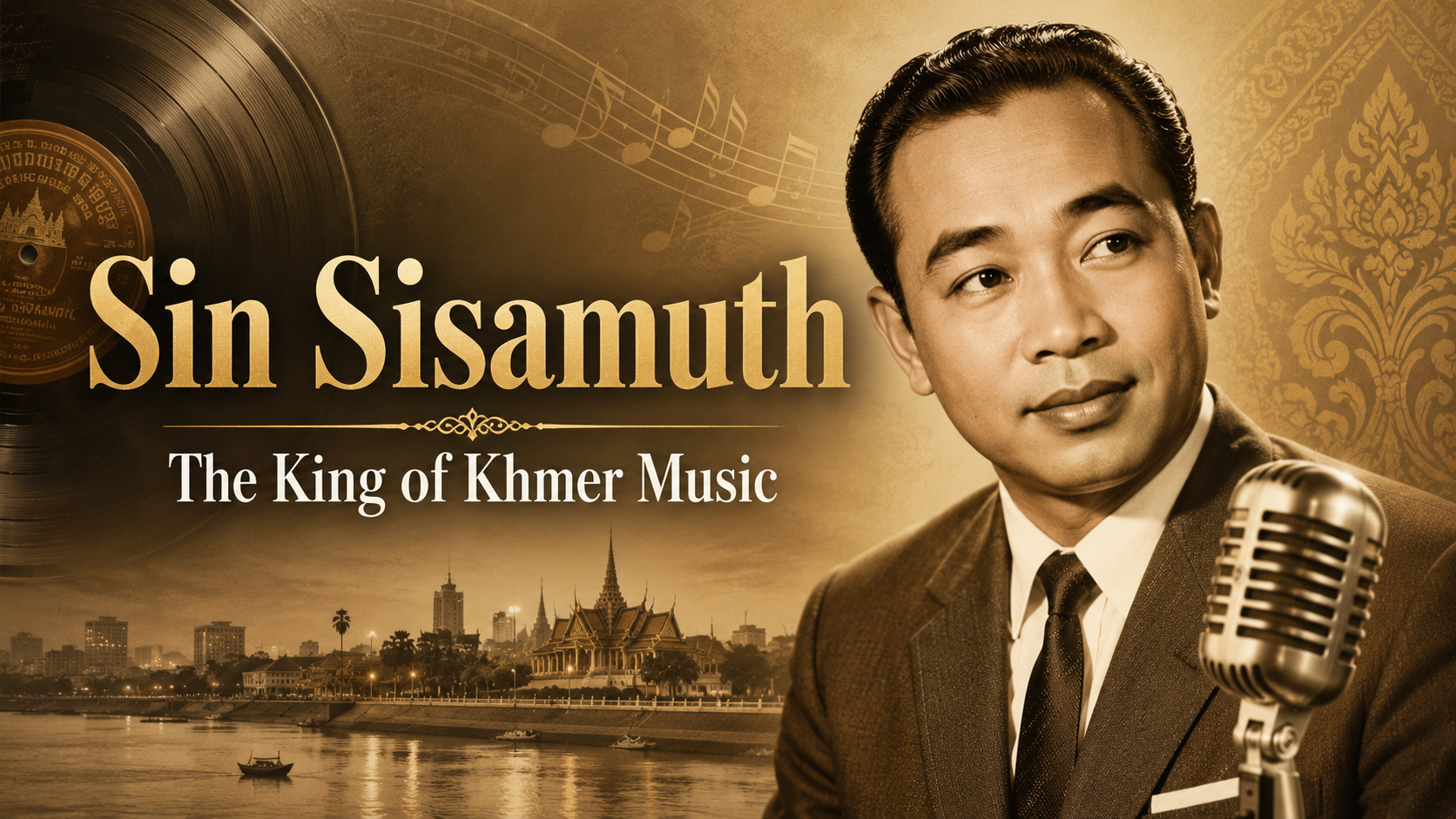
Sin Sisamuth — The King of Khmer Music
Sin Sisamuth: Why the King of Khmer Music Still Belongs in Every Guitarist’s Songbook
If you have spent any time playing Cambodian songs on guitar, you have already met Sin Sisamuth—even if you did not know his name.
Decades after Cambodia’s musical golden age, his melodies still appear at family gatherings, weddings, karaoke nights, and guitar circles. His songs pass from older listeners to younger players, often through memory before a chord sheet.
For anyone studying Khmer guitar, Sin Sisamuth is a doorway into Cambodian popular music.
Naming note: His name is written in English in several ways, including Sin Sisamuth and Sinn Sisamouth. ReanChord uses “Sin Sisamuth,” while many English-language historical sources use “Sinn Sisamouth.”
Who Was Sin Sisamuth?
Sin Sisamuth is widely remembered as the King of Khmer Music and one of the defining voices of twentieth-century Cambodia.
Sources disagree on his exact year of birth, commonly placing it in the early 1930s. What is clear is that he came from Stung Treng Province, later moved to Phnom Penh, and emerged as a major singer, songwriter, and composer during the 1950s.
His career grew alongside radio, cinema, nightclubs, and modern Cambodian popular culture. By the 1960s, his voice was among the best-known in the country.
He wrote and adapted songs, worked with leading musicians and lyricists, and moved confidently between styles. His catalogue is often described as enormous, although its exact size cannot be confirmed because so many records were lost.
A Voice That Could Carry Every Emotion
One reason Sin Sisamuth remains so beloved is the balance in his voice.
He could sound gentle without becoming weak, emotional without becoming uncontrolled, and elegant without losing the natural rhythm of Khmer speech. In slow songs, his phrasing often feels conversational, as though he is speaking directly to one listener. In faster songs, his timing becomes lighter and more playful.
That flexibility carried him through traditional-influenced melodies, romantic ballads, Latin rhythms, jazz, rock and roll, and film songs.
For guitarists, this variety matters. Some songs work with simple open-chord strumming; others invite fingerpicking, bass movement, seventh chords, or a fuller band arrangement.
Cambodia’s Musical Golden Age
Sin Sisamuth worked during a remarkable period in Cambodian cultural history.
From the 1950s through the early 1970s, musicians in Phnom Penh were listening outward while continuing to write in Khmer. Traditional Cambodian melody and poetic language met imported records, radio broadcasts, electric guitars, organs, brass instruments, Latin dance rhythms, soul, and rock and roll.
Cambodian artists reshaped those influences into a sound with its own identity.
Sin Sisamuth stood near the center of that movement, alongside artists such as Ros Serey Sothea, Pen Ran, Houy Meas, Mao Sareth, and many others. Calling him the King of Khmer Music recognizes how strongly his voice came to represent that generation.
Why His Songs Work So Well on Guitar
Many Sin Sisamuth songs are ideal for guitar because they combine memorable melodies with clear harmonic movement.
A beginner may hear an emotional arrangement and assume the chords are difficult. Often, the foundation uses familiar progressions such as:
1–5–6–4
6–4–1–5
1–4–5
In the key of , these may become:
– – –
or:
– – –
The magic comes from the melody, phrasing, rhythm, bass movement, and dynamics. You can begin with a simplified version, then gradually add detail.
Beginner Arrangement
Start with:
- one chord per measure
- simple down-strums
- a slow, steady tempo
- clear chord changes
Intermediate Arrangement
Then add:
- fingerpicked arpeggios
- bass-note movement
- slash chords such as or
- seventh chords such as , , or
- stronger contrast between verse and chorus
The same song can grow with you as your technique improves.
Learning His Phrasing, Not Only His Chords
A common mistake is to learn the chord names but ignore how the melody sits against them.
Sin Sisamuth’s phrasing is one of the most important parts of his style. He often allows a lyric to stretch across the bar line, enters gently after the beat, or holds a note while the harmony changes underneath it.
When practicing one of his songs:
- Listen to the original recording several times.
- Tap the pulse before touching the guitar.
- Notice exactly where each chord changes under the lyric.
- Sing the melody without playing.
- Add one simple strum per chord.
- Only then add a full strumming or fingerpicking pattern.
This process helps preserve the emotional shape of the song instead of reducing it to a mechanical chord loop.
A Legacy That Survived an Attempt at Erasure
Sin Sisamuth’s story cannot be separated from the destruction of Cambodia’s artistic community under the Khmer Rouge.
When the Khmer Rouge captured Phnom Penh in April 1975, artists, intellectuals, professionals, and people associated with the previous cultural life of the country faced extreme danger. Sin Sisamuth disappeared during the regime, and his exact final days remain uncertain. He is widely believed to have been killed, as were many musicians of his generation.
The regime destroyed recordings, archives, institutions, and lives. Yet the music survived.
Listeners hid records and tapes. Families remembered lyrics. Refugees and the Cambodian diaspora copied and shared recordings abroad. After the regime fell, songs returned through radio, performance, and digital archives.
Playing these songs today is therefore more than nostalgia. It is cultural continuity.
Where Guitarists Should Begin
New players should begin with slower, well-known ballads.
Look for songs with:
- three to five repeating chords
- a comfortable tempo
- clear verse and chorus sections
- a melody you already know well
Build the song in layers: learn the chord sequence, sing with a simple rhythm, then add dynamics, fills, fingerpicking, or alternate voicings.
Use ReanChord’s Transpose control when the original key does not fit your voice. After choosing the best singing key, use a capo when it gives you easier shapes such as , , , , or .
Turn on Autoscroll only after you can play the main progression without constantly looking at your hands.
You can explore available chords, lyrics, transpose tools, autoscroll, and romanized lyrics on the artist page:
Beginners can also follow the step-by-step introduction here:
Beginner’s Guide to Studying Khmer Chords
More Than a Historical Figure
Titles such as legend, golden voice, and King of Khmer Music are meaningful, but his importance becomes clearest when someone picks up a guitar and begins one of his songs.
A young player may simplify the chords while an older relative begins singing. In that moment, the music is not preserved behind glass. It is alive.
That is why his songs remain essential for anyone studying Khmer guitar.
They teach melody, timing, restraint, emotion, and cultural memory. They also remind us that a song can survive damaged tapes, missing records, forced silence, exile, and the passing of generations.
Learn one song, then another.
Soon you will understand why, decades after his disappearance, Sin Sisamuth is still called the King.
— Written by the ReanChord team.