
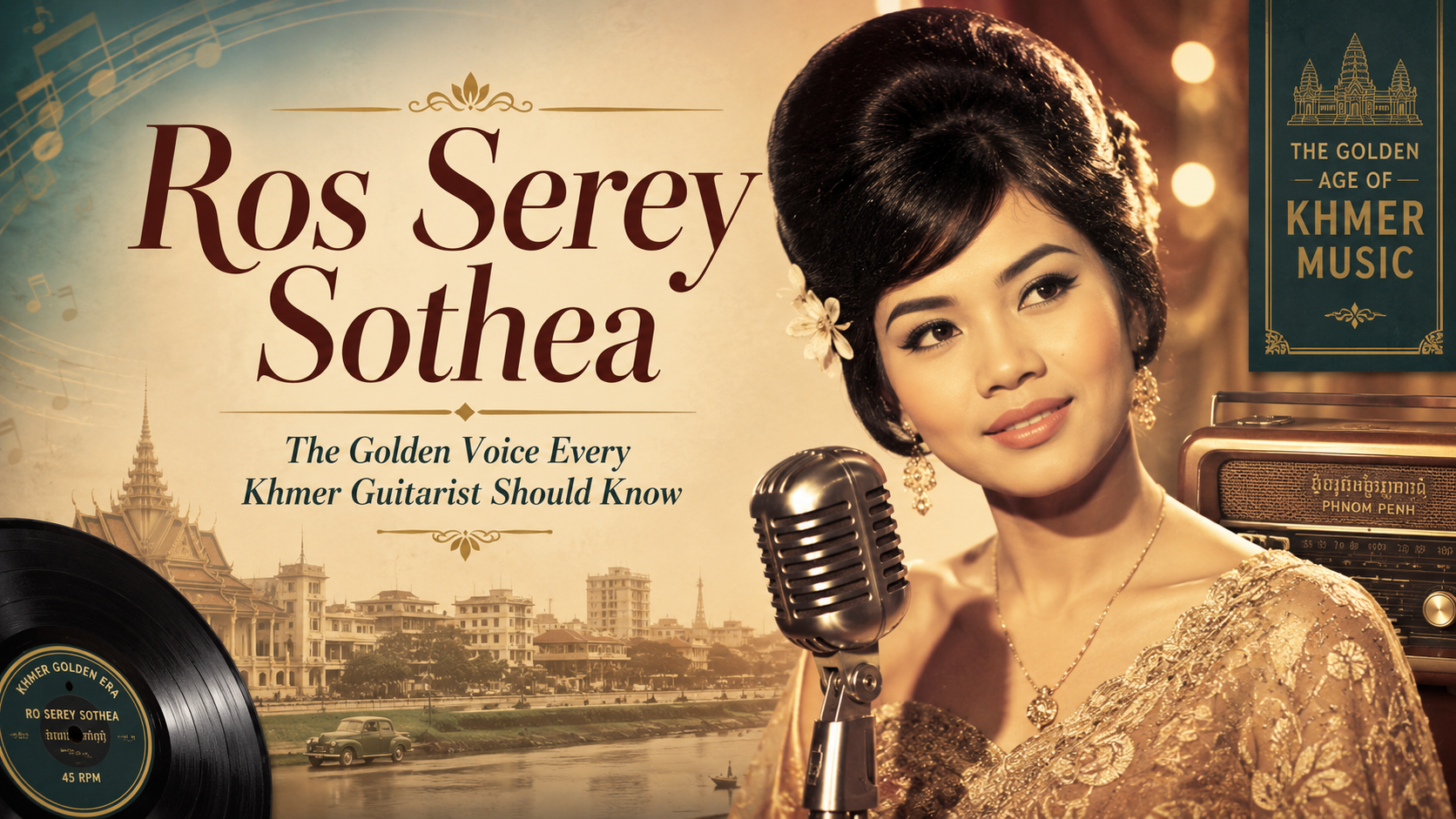
Ros Serey Sothea — The Golden Voice of Cambodia
Ros Serey Sothea
The Golden Voice Every Khmer Guitarist Should Know
Some voices are recognizable in a single note.
Ros Serey Sothea had one of them—high, clear, powerful, and emotionally direct. During Cambodia’s musical golden age, she became its most celebrated female singer.
For guitarists, her ballads are especially rewarding: the chords are often approachable, but the melodies are strong enough that even a simple acoustic version can move a room.
Naming note: Her name appears in English as Ros Serey Sothea, Ros Sereysothea, and other spellings. ReanChord uses “Ros Serey Sothea.”
From Battambang to Phnom Penh
Ros Serey Sothea was born around the late 1940s in Battambang Province. Accounts describe a modest rural upbringing and an exceptional natural singing voice.
She first gained attention through local performances and a regional singing competition. Her reputation grew until she was invited to Phnom Penh, where Cambodia’s radio, cinema, nightclub, and recording industries were rapidly expanding.
By the late 1960s, she had become a major national performer.
Her early hit “Stung Khieu,” often translated as “Blue River,” helped establish her public career. She later became a regular presence on national radio and recorded hundreds of solo songs and duets.
She entered a competitive capital-city scene and became one of its most unforgettable stars.
The Queen with the Golden Voice
Ros Serey Sothea was honoured with a royal title commonly translated as “Queen with the Golden Voice.”
The title suited her.
Her voice could be delicate without losing strength and powerful without sounding forced. She could move from a heartbreak ballad to an energetic rock or psychedelic performance with confidence.
Her range of styles included:
- Khmer romantic ballads
- traditional-influenced melodies
- romvong and saravan
- film music
- blues and bossa nova
- rock and roll
- psychedelic and garage rock
That variety is one reason her work still feels fresh.
A Defining Partnership with Sin Sisamuth
Ros Serey Sothea recorded many of her best-known duets with Sin Sisamuth.
Their voices complemented each other beautifully.
Sin Sisamuth often brought a warm, controlled, conversational quality. Ros Serey Sothea answered with brightness, power, and emotional clarity. Their duets could sound playful, romantic, sorrowful, or dramatic, depending on the song.
Together, they became one of the defining partnerships of Cambodia’s golden age.
Yet her solo recordings show a complete artist with her own unmistakable identity. She also worked with many performers, composers, filmmakers, and musicians who blended Cambodian melody with electric guitars, organs, drums, and international pop influences.
Why Guitarists Should Learn Her Songs
Ros Serey Sothea’s songs are excellent for guitar students because many combine simple harmony with memorable melodies.
A beginner may need only three to five chords for a recognizable version.
Common progressions may include patterns such as:
1–5–6–4
In the key of :
– – –
Or:
6–4–1–5
In the key of :
– – –
The chords may look simple, but the vocal phrasing gives the song its emotional identity.
Her songs are ideal for practicing smooth chord changes, singing while playing, gentle strumming, fingerpicking, dynamics, and Khmer lyrical phrasing.
Do Not Rush the Melody
The biggest challenge is often not the chord shape. It is matching the chords to the melody.
Ros Serey Sothea’s singing may enter slightly after the beat, stretch a phrase over a chord change, or hold a note while the harmony moves underneath it.
When learning one of her songs:
- Listen to the original several times.
- Tap the steady pulse.
- Read the lyrics without playing.
- Mark where each chord changes.
- Sing with one simple strum per chord.
- Add a full rhythm only when the timing feels natural.
This preserves the song’s emotional flow. A complicated pattern added too early can hide the phrasing that makes it special.
Building a Guitar Arrangement
Start with the simplest possible version.
Beginner Version
Use:
- open chords
- one or four down-strums per measure
- a slow tempo
- clear chord changes
Fingerpicked Version
For a ballad, try an arpeggio such as:
P – I – M – A – M – I
Let every note ring and keep the thumb steady.
Richer Version
As your playing improves, add:
- slash chords such as or
- seventh chords such as , , or
- bass movement
- short melody fills
- higher voicings during the chorus
The purpose is to support the melody, not complicate every chord.
Choosing the Right Key
Ros Serey Sothea’s original vocal range can be challenging for many singers.
Do not force your voice to match the original recording exactly.
Use ReanChord’s Transpose control to move the song into a comfortable key. Then use a capo when it gives you easier shapes such as:
, , , , and
A useful process is:
- Find a key that fits your voice.
- Check the chord shapes.
- Add a capo if it makes them easier.
- Retune.
- Practice the vocal entry before adding full rhythm.
A Voice Lost During the Khmer Rouge Era
Like many artists of her generation, Ros Serey Sothea disappeared after the Khmer Rouge took control of Cambodia in 1975.
The exact circumstances of her death remain unknown.
Different accounts describe different possible events, but no confirmed record explains her final days. It is safer to say she disappeared and is believed to have died during the Khmer Rouge period.
Her fate belongs to a larger tragedy in which Cambodia lost artists, musicians, filmmakers, teachers, writers, and countless others.
How the Golden Voice Survived
The regime failed to erase her music.
Recordings survived through hidden records, cassette copies, family collections, radio archives, and Cambodian communities abroad.
Later generations encountered her work through:
- copied tapes and compact discs
- reissued recordings
- documentary films
- international compilation albums
- cover bands and modern Cambodian artists
- online archives and streaming platforms
- graphic novels and stage productions
Her music now reaches listeners born decades after her disappearance. Every new performance extends that legacy.
Start Playing on ReanChord
You can find available chord sheets, lyrics, transpose tools, autoscroll, and romanized lyrics on her artist page:
New guitarists can begin here:
Beginner’s Guide to Studying Khmer Chords
Choose one of her slower songs and work one line at a time.
First make the chord changes clean, then match the lyric timing, dynamics, and expression.
More Than a Historical Recording
Ros Serey Sothea is often introduced as a singer from Cambodia’s lost golden age.
That description is true, but incomplete.
Her music is still sung, shared, covered, and played by new musicians, connecting Cambodian families across countries and generations.
For guitarists, one song can become a lesson in melody, restraint, timing, emotional phrasing, and cultural memory.
Learn one song carefully, play it for someone who remembers it, and teach it to someone new.
That is how the Golden Voice continues to travel.
— Written by the ReanChord team.