
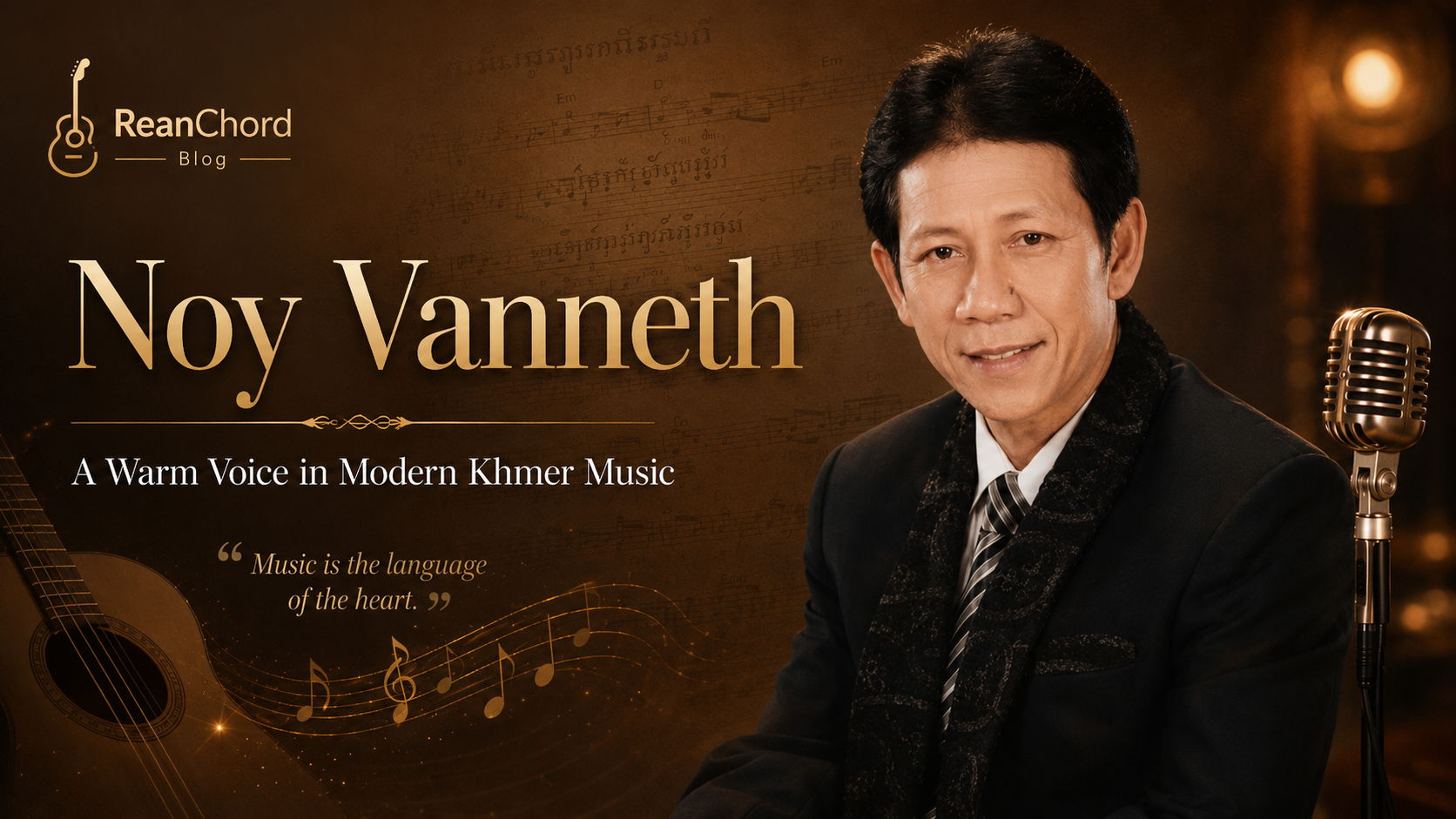
Noy Vanneth — A Beloved Khmer Vocalist
Noy Vanneth
A Warm Voice in Modern Khmer Music
Noy Vanneth is a well-loved figure in Cambodian music, known for a warm, steady voice and a catalogue of romantic and classic-style songs that have remained popular across generations.
For many listeners, his recordings carry the feeling of family gatherings, radio programs, and evenings spent singing familiar Khmer melodies. His songs place melody and lyrics at the center, making them especially satisfying on guitar.
Public biographical information about Noy Vanneth is limited. He is commonly described as a Cambodian singer born in the 1960s who built a long career performing and recording Khmer songs. What matters most here is the character of his voice, the durability of his songs, and their connection with guitar players.
A Voice Built for Storytelling
Noy Vanneth’s singing style is warm, controlled, and direct.
He does not need to overpower a song to make it emotional. Instead, he often lets the melody, phrasing, and lyrics carry the feeling. This makes his voice especially suited to romantic ballads and reflective songs.
A strong ballad singer knows when to hold back, stretch a phrase, and let a lyric settle.
That sense of patience is one of the most useful things guitarists can learn from his music.
When playing one of his songs, avoid rushing. Let the chords support the voice rather than compete with it.
His Musical Style
Noy Vanneth’s catalogue leans toward melodic Khmer ballads, classic-style popular songs, and sentimental arrangements.
Many of these songs are built around:
- clear melodies
- repeated chord progressions
- relaxed tempos
- emotional lyrics
- strong verse-and-chorus structure
- arrangements that leave room for the singer
This style works naturally on acoustic guitar.
A simple progression such as:
– – –
or:
– – –
can carry a full song when the melody and dynamics are handled well.
A song does not need many chords to sound complete.
Why His Songs Work Well on Guitar
Noy Vanneth’s songs are useful for guitar students because many move at a comfortable pace and repeat a small group of chords.
This lets you focus on:
- clean chord shapes
- smooth transitions
- steady timing
- singing while playing
- changing chords on the correct syllable
- using dynamics
A slower tempo gives your hand more time to move and your ear more time to hear whether the chord is clean.
This makes his music a good bridge between basic chord exercises and complete-song performance.
Begin with the Simplest Version
Do not try to copy every detail of the original arrangement immediately.
Start with one down-strum each time the chord changes.
For example:
| C | G | Am | F |
Play one strum and let each chord ring.
Once you can sing the lyric without losing the chord changes, add four down-strums per measure:
1 2 3 4
Then add up-strums, fills, or fingerpicking.
A simple version played steadily will sound better than a detailed version that stops during every change.
Match the Chords to the Words
In melody-led songs, chord timing is especially important.
The chord name on ReanChord appears above the syllable where the change happens. Do not wait until the word is finished.
Use this practice method:
- Read the lyrics aloud.
- Say the chord names at the change points.
- Tap the beat with your foot.
- Play one strum per chord.
- Add the melody.
- Keep the rhythm simple until the timing is secure.
This trains your eyes, hands, and voice together.
Fingerpicking for Romantic Ballads
Many Noy Vanneth songs sound beautiful with gentle fingerpicking.
Try a simple PIMA pattern:
P – I – M – A – M – I
The thumb plays the bass note, while the index, middle, and ring fingers play the upper strings.
On a chord, the thumb usually begins on the 5th string.
On a or chord, the thumb may begin on the 6th string.
Keep the pattern slow and even. Let the notes overlap and ring.
Fingerpicking should support the melody.
Use Dynamics to Shape the Song
A good guitar arrangement should not stay at the same volume from beginning to end.
Try this shape:
- intro: soft arpeggio
- verse: light strumming
- pre-chorus: gradually stronger
- chorus: fuller sound
- final verse: return to soft
- final chorus: strongest section
- outro: let the last chord ring
This creates emotional movement without changing the chord progression.
Dynamics can make four chords feel complete.
Choosing the Right Key
The original key may not suit every singer.
Use ReanChord’s Transpose control to move the song higher or lower.
Transpose when:
- the melody is too high
- the melody is too low
- the original key contains difficult chords
- you need to match another instrument
Move the song one semitone at a time and test both the lowest and highest notes.
The best key must feel natural for both guitar and voice.
Using a Capo
After finding the right key, use a capo if it gives you easier chord shapes.
For example, difficult barre chords may become familiar shapes such as:
, , , , and
A useful process is:
- Transpose until the melody fits your voice.
- Check the new chord names.
- Choose a capo position that produces easier shapes.
- Attach the capo close behind the fret.
- Retune before playing.
Transpose chooses the sounding key. The capo helps you choose practical shapes.
A Simple Practice Routine
Minutes 1–3: Tune
Tune all six strings.
Minutes 4–6: Check the Chords
Build each shape and pick the strings separately.
Minutes 7–9: Practice Changes
Repeat the two hardest chord changes slowly.
Minutes 10–12: Play the Chorus
Use one strum per chord.
Minutes 13–15: Add Rhythm
Use gentle down-strums or a simple fingerpicking pattern.
Minutes 16–20: Play Without Stopping
Continue through small mistakes and return to the beat.
This develops performance confidence.
Learning the Complete Song
Many beginners learn only the chorus or the most recognizable part.
That is a useful starting point, but eventually you should learn the complete structure:
- intro
- verse
- chorus
- instrumental break
- bridge
- final chorus
- outro
Playing from beginning to end teaches memory, endurance, recovery, and arrangement.
Record and Listen Back
Use your phone to record a full practice run.
Then listen for:
- uneven rhythm
- buzzing strings
- late chord changes
- sections that are too loud
- pauses before difficult shapes
- lyrics that do not align with the chords
Recording reveals problems that are easy to miss while singing and playing. Also notice what is improving.
Start Playing on ReanChord
You can browse available Noy Vanneth chord sheets with transpose, autoscroll, and romanized lyrics on his artist page:
New guitarists can begin here:
Beginner’s Guide to Khmer Chords
Choose one slower song and take it one line at a time.
First learn the chord changes. Then match them to the words. Finally, add rhythm, dynamics, and expression.
Why His Songs Continue to Matter
Noy Vanneth’s songs show that emotional music does not need to be complicated.
A memorable melody, a warm voice, and a clear progression can be enough to carry a room.
For guitarists, that simplicity creates room to focus on:
- timing
- tone
- phrasing
- dynamics
- connection with the listener
Learn one song carefully. Play it with patience. Let the melody lead.
That is where the music begins to feel alive.
— Written by the ReanChord team.