
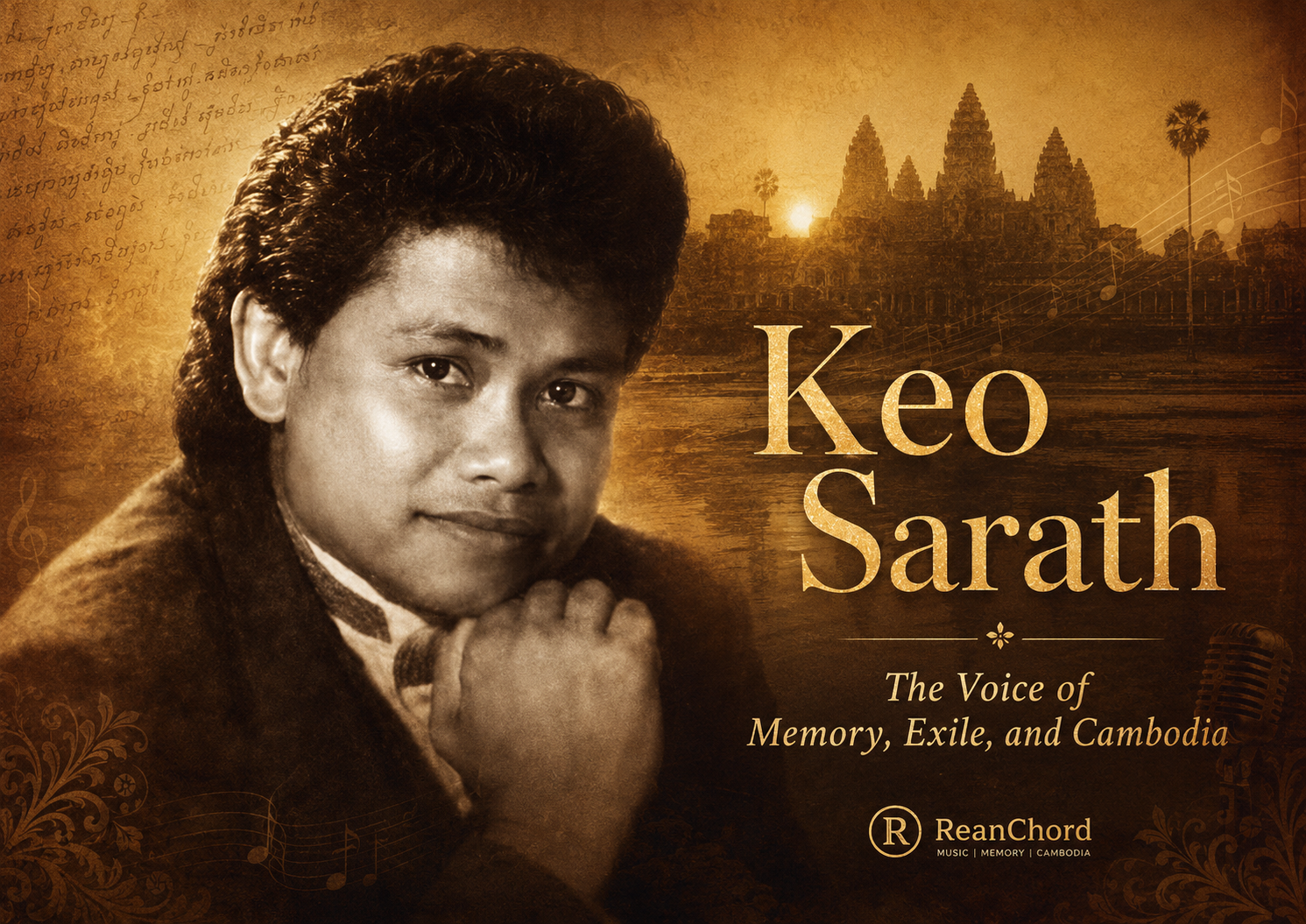
Keo Sarath — A Voice of Cambodia's Golden Age
Keo Sarath: The Voice of Memory, Exile, and Cambodia
Keo Sarath belongs to a different chapter of Cambodian music from the singers of the 1960s golden age.
Born in 1956, he survived the Khmer Rouge period and became known for songs about displacement, nostalgia, love of Cambodia, refugee life, and rebuilding after catastrophe.
For guitarists, his direct melodies and repeating progressions are approachable while still carrying deep emotional weight.
Historical note: Keo Sarath’s public career developed after the Khmer Rouge period, not during the 1960s golden age.
From Battambang to a Life of Displacement
Keo Sarath was born in Battambang Province in 1956.
He survived the Khmer Rouge regime and later lived in a refugee camp near the Khmer–Thai border.
That experience deeply influenced songs connected to:
- separation from home
- refugee life
- war and political upheaval
- memory of Cambodia
- personal heartbreak
- survival and rebuilding
His songs became part of the emotional record of a displaced generation.
A Singer of the Postwar Cambodian Experience
After the Khmer Rouge era, Cambodian music had to rebuild.
Many singers, musicians, composers, and filmmakers had been killed or disappeared. Recordings and archives were lost.
Keo Sarath emerged during this later period.
His music spoke to people living with the consequences of that period.
His songs often looked backward:
- remembering a lost homeland
- grieving the past
- describing life in exile
- hoping for peace
- longing to return
His work captures history that official documents cannot fully preserve.
His Musical Style
Keo Sarath’s songs are often melodic, slow, and emotionally direct.
Many use classic Khmer phrasing and clear verse-and-chorus structures.
For guitarists, this style works naturally with:
- gentle down-strums
- slow arpeggios
- fingerpicking
- bass-note movement
- simple open chords
- soft dynamic changes
A progression such as:
– – –
can support a deeply emotional song when the melody and lyrics are given enough space.
Another common pattern might be:
– – –
The emotion comes from phrasing, timing, and tone.
Why His Songs Are Good for Guitar Learners
Many of his songs move slowly and repeat a small group of chords.
That gives you time to practice:
- clean fretting
- smooth chord transitions
- matching changes to lyrics
- playing with steady timing
- singing while accompanying yourself
- controlling volume and emotion
A slower song teaches discipline because buzzing strings, late changes, and uneven rhythm are easier to hear.
This makes slow music excellent practice.
Begin with One Strum per Chord
Start with the simplest possible version.
Suppose the progression is:
– – –
Play one down-strum when each chord begins.
Let the chord ring.
Do not add a full strumming pattern until you can change chords without stopping.
Then try four down-strums per measure:
1 2 3 4
Once that feels steady, add light up-strums or a gentle fingerpicking pattern.
The goal is to support the song clearly.
Fingerpicking for Reflective Songs
Keo Sarath’s slower songs often sound beautiful with fingerpicking.
Try this simple PIMA pattern:
P – I – M – A – M – I
The thumb plays the bass string, while the index, middle, and ring fingers play the upper strings.
On or , the thumb often begins on the 5th string.
On or , it may begin on the 6th string.
Keep the pattern slow and let the notes overlap.
This creates a flowing, reflective sound.
Let the Lyrics Control the Arrangement
In this kind of music, the lyrics matter as much as the chords.
Do not strum so heavily that the words disappear.
A good arrangement might use:
- a soft fingerpicked intro
- light verse accompaniment
- stronger strumming in the chorus
- a short instrumental break
- a gentle final chord
Let the guitar follow the song’s emotional shape: grow slightly with intensity, then reduce the strumming when the lyric becomes reflective.
Playing by Ear
Keo Sarath’s clear melodies make his songs useful for ear training.
Begin by finding the home chord.
Listen to where the song feels settled, especially at the end of a phrase.
Then test the most common chords in the key.
In a major key, begin with:
1, 4, and 5
In a minor-feeling song, try the relative minor and related chords.
For example, in the key of , test:
, , , and
Use ReanChord afterward to check your answer.
This turns every song into ear training.
Choosing a Comfortable Key
The original key may not fit your voice.
Use ReanChord’s Transpose control to move the song higher or lower.
Transpose when:
- the melody feels too high
- the melody sits too low
- the original chords are difficult
- you need to match another singer or instrument
Move one semitone at a time and test the full vocal range.
Check both the verse and chorus before choosing the key.
Using a Capo
After finding the right key, try a capo if it creates easier shapes.
Useful beginner shapes include:
, , , , , and
A simple workflow is:
- Transpose until the melody fits your voice.
- Check the chord shapes.
- Choose a capo position that simplifies them.
- Place the capo just behind the fret.
- Retune the guitar.
Transpose changes the true key. The capo changes the shapes you play.
Songs as Historical Memory
Keo Sarath’s songs preserve emotional history.
They express what statistics and timelines cannot fully communicate:
- what it felt like to leave home
- what it meant to survive
- how refugees remembered Cambodia
- how music helped people endure loss
- how identity continued across borders
The songs belong to a wider Cambodian experience and function as cultural memory.
Life in the Diaspora
After living in a refugee camp, Keo Sarath later moved to the United States.
Like many Cambodian artists abroad, he carried Khmer music into diaspora communities.
Music preserved language, memory, and connection across diaspora communities.
Keo Sarath’s recordings became part of that bridge between homeland and diaspora.
His Early Death and Lasting Legacy
Keo Sarath died in 1991 in California at the age of 35.
Although his life was short, his songs continued through tapes, karaoke, radio, covers, and digital platforms.
Many are now treated as Cambodian classics, covered by younger singers and remembered by listeners from the refugee years.
For new guitarists, learning one of his songs is a way to connect with that history.
Start Playing on ReanChord
You can find available Keo Sarath chord sheets, transpose controls, autoscroll, and romanized lyrics on his artist page:
New guitarists can begin here:
Beginner’s Guide to Reading Khmer Chords
You may also enjoy:
Sin Sisamuth: The King of Khmer Music
They belong to different eras but both shaped Cambodian musical memory.
A Simple Practice Plan
- Minutes 1–3: Tune.
- Minutes 4–6: Review every chord.
- Minutes 7–9: Practice the hardest changes.
- Minutes 10–12: Speak the lyrics with one strum per chord.
- Minutes 13–15: Add gentle strumming or fingerpicking.
- Minutes 16–20: Play without stopping.
Record yourself and listen for timing and tone.
Final Thoughts
Keo Sarath’s music shows that a simple song can carry the weight of history.
For guitarists, his work teaches patience, phrasing, dynamics, and cultural memory.
Start slowly.
Let the melody lead.
Give the lyrics space.
Every new performance keeps another part of Cambodia’s story audible.
— Written by the ReanChord team.