

How Guitarists Can Learn Songs Faster and Play with Confidence
How Guitarists Can Learn Songs Faster and Play with Confidence
Learning a new song is difficult when you try to change chords, keep rhythm, read lyrics, sing, and avoid stopping at the same time.
A better approach is to divide the song into smaller skills and build them in order.
1. Choose the Right Song
Choose a song slightly above your current level, not far beyond it.
A good practice song should have:
- three to six chords
- a clear verse and chorus
- a slow or medium tempo
- repeated progressions
- chord shapes you mostly recognize
- lyrics you already know
Avoid songs with many barre chords, fast changes, and difficult rhythm. Finishing an easier song builds confidence.
2. Listen Before You Play
Listen to the complete song before playing.
Try to identify:
- the intro
- the verse
- the chorus
- the bridge
- the loudest section
- the quietest section
- repeated chord patterns
Tap your foot and count:
1 2 3 4
Knowing the structure makes the chord sheet easier to follow.
3. Check the Key and Chords
Open the song on ReanChord and review the chord list.
For example:
– – –
Build each chord slowly and pick every string.
Listen for:
- buzzing strings
- muted notes
- fingers touching nearby strings
- incorrect starting strings
Learn every shape before adding rhythm. The chords do not need to be perfect, but they should be recognizable and reasonably clean.
4. Isolate the Hardest Chord Change
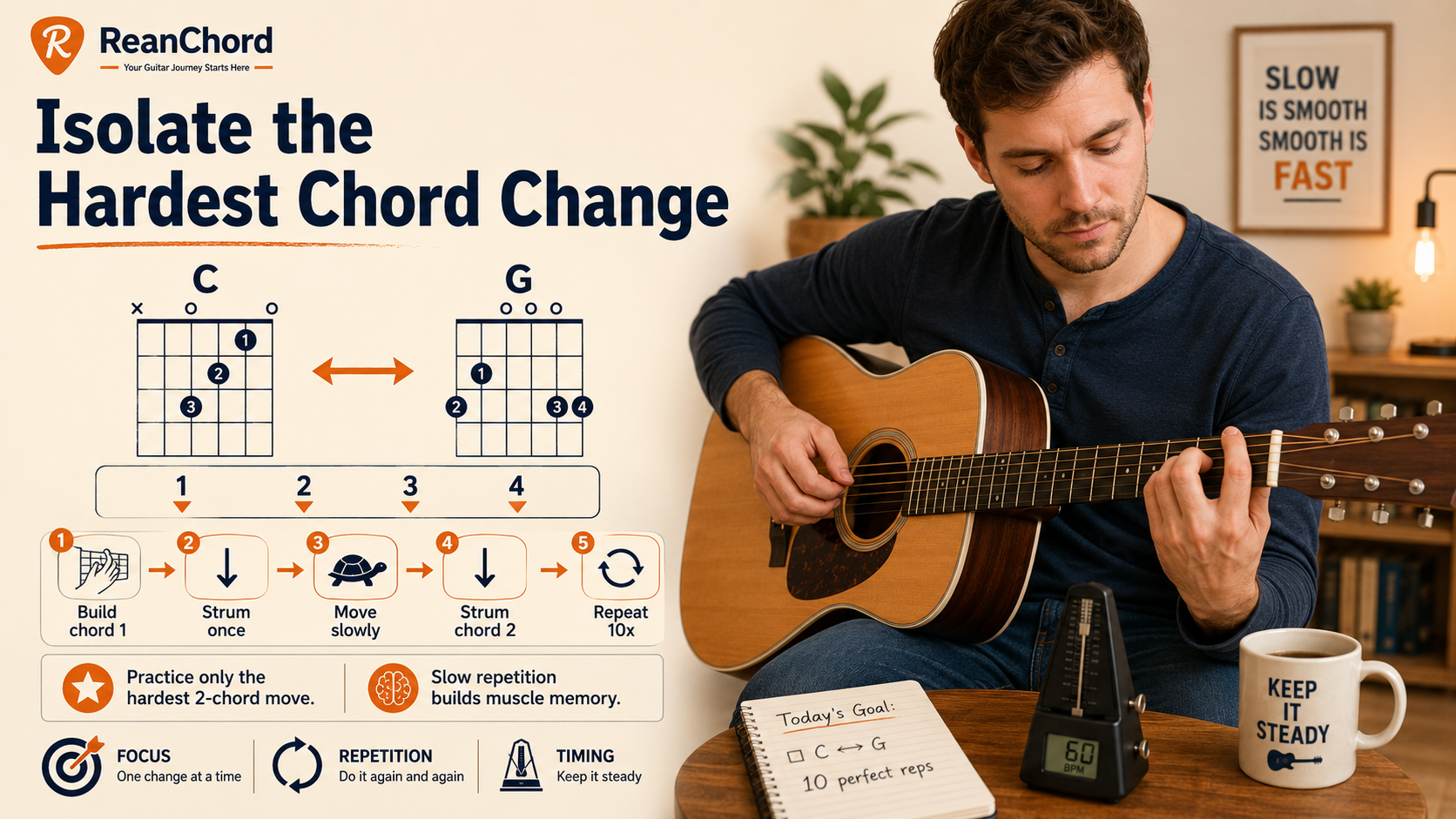
Most songs contain one or two changes that cause most mistakes.
Examples:
→
→
→
Do not repeat the full song hoping the change improves automatically. Isolate the two chords.
Use this method:
- Build the first chord.
- Strum once.
- Move slowly to the second chord.
- Strum once.
- Return to the first chord.
- Repeat ten times.
Keep the fingers close to the strings, then practise the change in time:
1 2 3 4
Change after beat 4.
Five focused minutes can save much more time later.
5. Learn the Chorus First
Begin with the chorus because it repeats and is easy to remember.
Open the chorus on ReanChord.
Turn on Highlight and look at the exact syllable below each chord.
Start with one down-strum at every change.
Example:
[C]I still remember the [G]night
When [Am]you told me everything was [F]fine
First make sure each change happens at the correct lyric position. Repeat the chorus slowly before adding full strumming.
6. Use a Simple Rhythm First
Complicated strumming too early can slow your progress.
Begin with four down-strums:
1 2 3 4
D D D D
Then try continuous down-up movement:
1 & 2 & 3 & 4 &
D U D U D U D U
A common pop pattern is:
D D U U D U
Keep the hand moving like a pendulum. Reduce the tempo if the rhythm stops.
A simple steady pattern sounds better than an uneven advanced one.
7. Practise in Small Sections
Do not always begin at the intro.
Divide the song into sections:
- intro
- verse
- chorus
- bridge
- outro
Practise each section separately, then connect them in pairs:
Verse → Chorus
Chorus → Verse 2
Bridge → Final Chorus
Transitions are often harder than the sections, so practise them directly.
8. Slow the Song Down
Slow practice helps your brain and fingers understand the movement.
Use a metronome and begin around 50–60 BPM.
When you can play the section three times without stopping, increase the tempo by 5 BPM.
Increase the speed only after repeatable, controlled attempts.
A useful tempo routine is:
60 BPM → 65 BPM → 70 BPM → 75 BPM
If mistakes return, reduce the tempo and rebuild accuracy.
9. Use Transpose to Fit Your Voice
A song may be easy to play but uncomfortable to sing.
Use ReanChord’s Transpose control to move the song higher or lower.
Test the highest note of the chorus.
If you need to strain, lower the key.
If the verse becomes too low, move the key slightly higher.
Change one semitone at a time. A comfortable key makes singing and playing easier to coordinate.
10. Use a Capo for Easier Shapes
The best vocal key may contain difficult chords.
For example:
– – –
With a capo at fret 3, you may play:
– – –
The song still sounds in , but your hand uses easier shapes. Use ReanChord’s Capo feature, place the capo close behind the fret, and retune.
11. Learn Singing and Playing Separately
Singing while playing combines two skills, so practise them separately first.
Guitar Only
Play the full progression without lyrics.
Voice Only
Sing while tapping the beat.
One Strum per Chord
Combine the voice with one down-strum at each change.
Full Rhythm
Add the complete strumming pattern only after the timing feels secure.
If the rhythm breaks when you sing, return to the simpler version and rebuild coordination.
12. Use Autoscroll Correctly
Turn on Autoscroll only after you understand the song structure.
Set it so the next line appears before you need it. Too fast causes rushing; too slow creates waiting.
Practise manually first. Autoscroll should support the performance, not control it.
13. Record Yourself
Recording quickly reveals problems.
Use your phone and play one full verse or chorus.
Listen for:
- uneven tempo
- buzzing chords
- late changes
- pauses before difficult shapes
- weak strumming
- lyrics that do not match the chord changes
- sections that become too fast
Correct one main problem, then record again.
14. Do Not Restart After Every Mistake
Restarting after every mistake creates a strong beginning and a weak ending.
During performance practice, continue through mistakes.
If you miss a chord:
- keep the strumming hand moving
- listen to the beat
- return on the next chord
- continue the section
A confident player knows how to recover from mistakes.
15. Use a 20-Minute Practice Routine
Use this focused routine:
Minutes 1–3
Tune the guitar.
Minutes 4–6
Review every chord.
Minutes 7–10
Practise the hardest chord change.
Minutes 11–14
Work on one song section.
Minutes 15–17
Practise rhythm with a metronome.
Minutes 18–20
Play without stopping.
Short daily practice is more effective than one long weekly session.
Common Problems
Chord Changes Are Too Slow
Isolate two chords and repeat them without playing the full song.
Rhythm Stops
Slow down and keep the strumming hand moving.
The Song Is Too High
Use Transpose to lower the key.
The Chords Are Too Difficult
Try a capo or simplified version.
Lyrics Are Hard to Follow
Use Highlight or Romanized Lyrics.
You Always Forget the Next Section
Write the structure:
Intro → Verse → Chorus → Verse → Chorus → Outro
Final Checklist
Before calling the song complete, check whether you can:
- play every chord clearly
- change through the main progression
- keep a steady beat
- play the chorus without stopping
- connect the verse and chorus
- use the correct key
- use a capo if needed
- follow Highlight
- use Autoscroll comfortably
- recover after a mistake
- record one complete performance
You need a complete version, not a perfect recording.
Final Encouragement
Learning faster is not about rushing. It is about practising the right problem at the right time.
Listen first.
Learn the chords.
Isolate difficult changes.
Start with simple rhythm.
Connect the sections.
Then perform without stopping.
Every finished song improves timing, memory, confidence, and musical understanding. Each completed song makes the next easier.
— Written by the ReanChord team.