
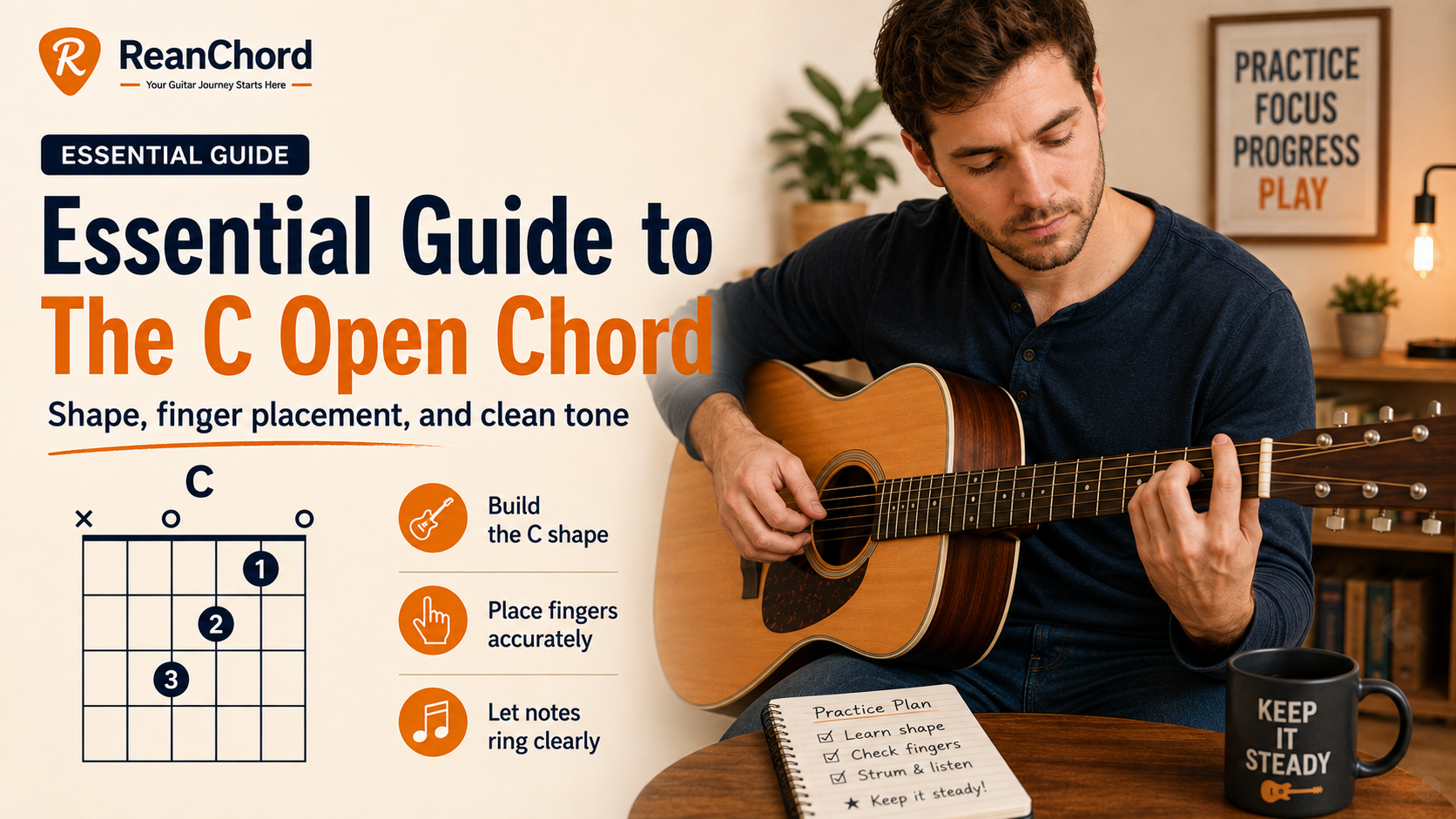
Essential Guide to The `C` Open Chord
The Open Chord is a practical guitar skill that can improve tone, timing, confidence, and song learning when it is practised correctly. Develop curved fingers and accurate string selection while playing the essential major shape.
A focused method turns this topic from something confusing into a repeatable part of daily practice.
This lesson gives you a clear method, a real-song application, a ReanChord workflow, and a progress check. The goal is not to complete the article in one sitting. Work through one section, listen carefully, and repeat only the movement that needs improvement.
Why This Matters
Open chords are the core vocabulary of beginner accompaniment. Clear individual strings and accurate starting-string control matter as much as remembering the shape.
For the open chord, listen for three things: a clean sound, a stable pulse, and relaxed movement. If one of those disappears, slow down and reduce the task.
A useful reference for this topic is:
Develop curved fingers and accurate string selection while playing the essential `C` major shape.
4 focused repetitions before increasing difficulty
Set Up the Practice
Tune the guitar, sit or stand in a balanced position, and remove distractions. Set a tempo that feels almost too easy. Easy tempo gives you enough attention to notice buzzing, late movement, uneven attack, or tension.
Practise for quality rather than endurance. Ten accurate repetitions are more valuable than fifty rushed attempts. After each small set, release the hands, breathe, and check whether the next repetition can be cleaner.
Core Method
Use this simple learning order:
- Observe: identify what the fretting hand, picking hand, ear, and eyes must do.
- Simplify: remove singing, fast tempo, and full-song pressure.
- Repeat: practise one accurate movement several times.
- Connect: place the movement inside a two-chord or two-measure loop.
- Apply: use it in a verse or chorus.
- Review: record a short attempt and correct one problem.
Topic reference:
`C`: x32010; begin the strum from the 5th string`
For a song exercise, use this progression:
| `C` | `G` | `Am` | `F` |
Begin with one controlled action per chord. Add the complete rhythm only when the movement remains accurate through the whole loop.
Apply It to a Real Song
Choose a slow or medium-tempo song that uses familiar chords. Open the chorus first because it is usually repeated and easy to remember.
Use this order:
- Read the chord line without playing.
- Speak or hum the lyric while tapping the beat.
- Play one down-strum at every chord change.
- Repeat the hardest two-measure section five times.
- Play the complete chorus without restarting.
- Add the verse and connect the transition.
A useful practice loop is:
`D` – `A` – `Bm` – `G`
`C`: x32010; begin the strum from the 5th string`
Do not judge the attempt only by whether every chord was perfect. Check whether the tempo continued, whether the correct section arrived next, and whether you recovered after a small mistake.
ReanChord Workflow
Use ReanChord to reduce screen handling and keep attention on the music:
- Turn on Highlight.
- Read one line before playing.
- Notice the lyric syllable below each chord.
- Use one down-strum at each marked change.
- Add the complete rhythm only after the timing is correct.
The tool should support listening and timing. If the feature makes you rush or stare at the screen, simplify the settings and practise manually again.
Common Problems and Fixes
1. Treating the open chord as a shape only
Focus on the sound, timing, and physical movement. The result should remain useful when the chord, tempo, or song section changes.
2. Adding complexity too early
Return to one strum, one chord, or one small section until the basic timing is stable.
3. Practising without listening
Record a short attempt and compare the sound with the intended rhythm, tone, or chord change.
4. Inconsistent repetition
Use the same starting position, count, and tempo so each attempt trains the same movement.
5. Rushing
Reduce the tempo and count aloud. Speed should come from familiar movement, not urgency.
6. Watching only one hand
Practise the motion slowly enough that you can alternate attention between the fretting hand, picking hand, and chord sheet.
Progress Check
You are making useful progress when you can:
- explain the purpose of the open chord in one sentence
- demonstrate it slowly without unnecessary tension
- keep a steady count or pulse
- use it through at least two chord changes
- apply it to one complete chorus or verse
- recover after a small mistake without restarting
- identify the next specific detail to improve
Do not wait for perfection before using the skill in music. Isolated practice builds control, but songs build timing, memory, and confidence.
Final Encouragement
Small improvements become dependable technique when they are repeated clearly. Slow the movement, listen to the result, and connect it to a real song as soon as possible.
A guitarist who can stay in time, simplify a difficult section, and recover calmly will sound more musical than a guitarist who knows many shapes but cannot complete a song.
Keep the practice focused. One accurate change, one steady measure, and one finished section are real progress.
— Written by the ReanChord team.