
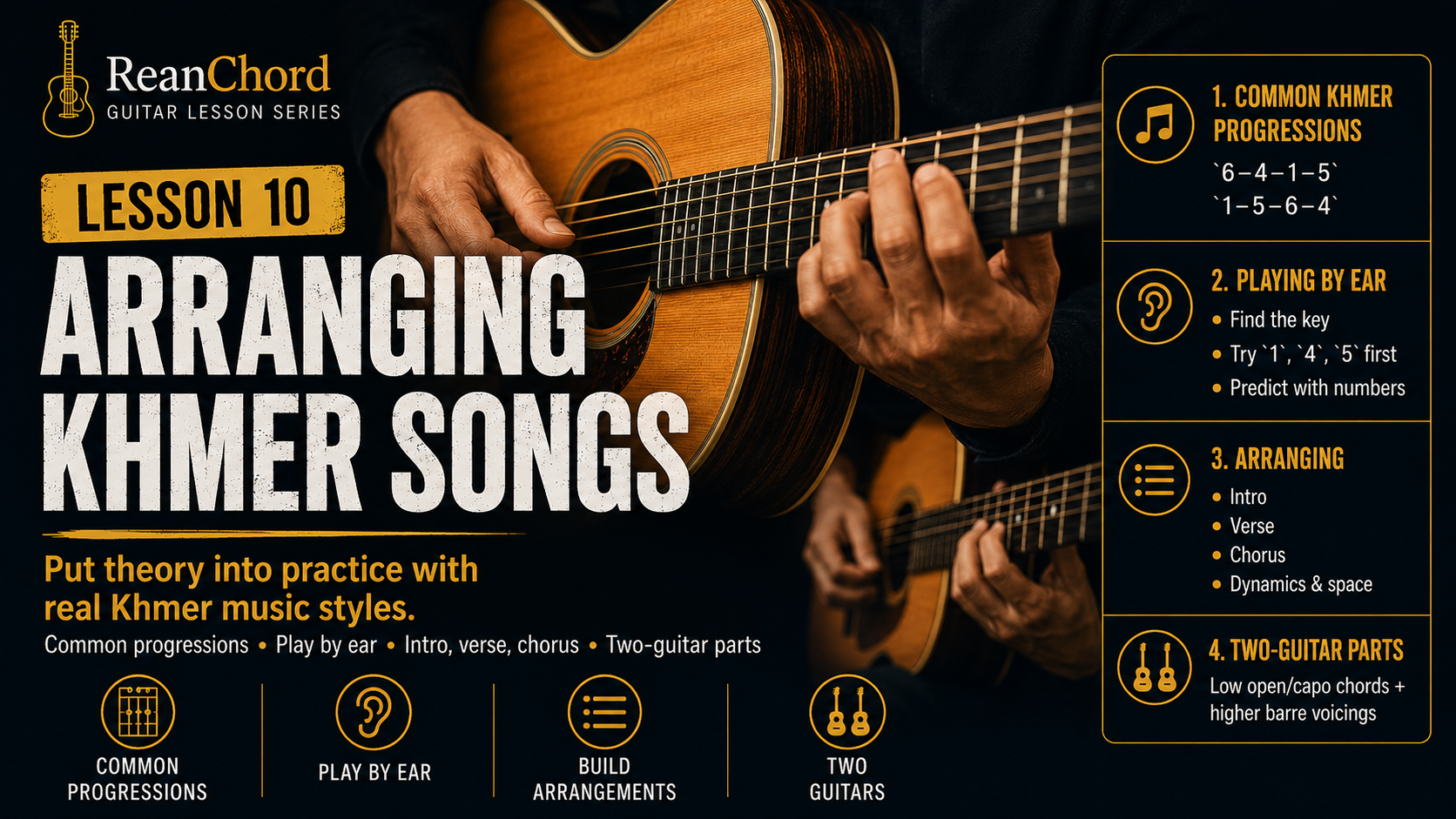
Advanced · Playing & Arranging Khmer Songs
Arranging Khmer Songs
Learning chords and theory becomes much more exciting when you apply them to real music. Khmer songs give you a perfect place to do that.
Many Khmer ballads, worship songs, and pop songs use familiar progressions and clear contrast between verse and chorus. That makes them excellent material for practicing rhythm, fingerpicking, arranging, and playing by ear.
Chord-label rule: Every chord name in this lesson is marked like , , , , or .
1. Common Khmer Progressions
Many Khmer ballads rely on familiar number-system patterns.
Two of the most common are:
6–4–1–5
1–5–6–4
These progressions sound emotional and smooth, so they appear often in love songs and slow songs.
6–4–1–5
In the key of , this becomes:
– – –
In the key of , it becomes:
– – –
This progression often feels reflective or heartfelt.
1–5–6–4
In the key of , this becomes:
– – –
In the key of , it becomes:
– – –
This is a very common pop progression and appears often in Khmer modern songs.
Dance Patterns
Romvong and Saravan styles often depend on stronger, simpler patterns such as:
1–4–5
In the key of , that is:
– –
In the key of , that is:
– –
These styles need steady pulse and even rhythm more than complex harmony.
2. Playing Khmer Songs by Ear
Playing by ear is the skill of hearing a song and finding the notes or chords without relying only on written charts.
Khmer songs are a good training ground because many use clear melodies and familiar progressions.
Find the Key
Start by finding the “home” note.
Hum the note that feels most stable, especially at the end of a phrase or at the end of the song. Then match that note on the guitar.
That note is often the key center, or 1.
If the song feels like it comes to rest on , then the key may be C major or A minor. Your next job is to decide whether the song sounds major or minor.
Try 1, 4, and 5 First
Once you identify the key, try the 1, 4, and 5 chords.
These three chords fit a huge number of songs.
For example, in the key of , test:
– –
Predict with Numbers
Use your knowledge of common progressions.
If the song begins on 6, and then moves emotionally upward, there is a good chance 4, 1, and 5 may follow.
If the song has a brighter pop feeling, try 1–5–6–4.
3. Building a Simple Arrangement
An arrangement is the way you organize the guitar part for the whole song.
Even with the same progression, the music becomes more expressive when the intro, verse, and chorus each have their own shape.
Intro
A good intro introduces the mood of the song.
You can:
- pick out the main vocal melody
- play an arpeggiated chord loop
- use a signature riff
- begin with soft harmonics or a light picking figure
If the song starts gently, a fingerpicked intro often works well.
Example:
– – –
played slowly as an arpeggio can create a smooth emotional opening.
Verse
The verse usually supports the singing, so do not overcrowd it.
Good verse textures include:
- soft fingerpicking
- light down-strums
- palm-muted rhythm
- sparse bass-note and chord combinations
The goal is to leave space for the melody and lyrics.
Chorus
The chorus usually carries more emotional energy.
Open up the sound by using:
- fuller strumming
- wider dynamics
- stronger accents
- higher voicings
- thicker rhythm
If the verse uses fingerpicking, the chorus may switch to strumming. That contrast helps the chorus feel bigger.
4. Dynamics and Space
In arranging, dynamics and space matter as much as the chord names.
A song sounds musical not only because of what you play, but also because of what you do not play.
Dynamics
Dynamics means changing the volume and intensity.
For example:
- intro = soft
- verse = soft to medium
- pre-chorus = growing
- chorus = full and open
- final chorus = strongest
- outro = relaxed again
This emotional shape is very important in Khmer ballads.
Space
Do not fill every beat with sound.
Sometimes one well-placed strum is stronger than a busy pattern.
Let chords ring. Leave room after a vocal phrase. Use silence to create breath in the arrangement.
5. Two-Guitar Arrangements
If two guitarists are playing together, they should not both play the exact same shape in the same place.
A better arrangement is to share the same harmony while using different registers.
Guitar 1: Low and Open
The first guitar can play:
- open chords
- capo chords
- simple strumming
- lower register patterns
Example:
– – –
using open shapes near the nut.
Guitar 2: Higher and Lighter
The second guitar can play:
- barre voicings
- higher triad shapes
- arpeggios
- melody fills
This guitar stays in the same key but in a higher range, so both guitars support the song without fighting for space.
Example
Guitar 1:
– – –
with open strumming
Guitar 2:
higher voicings of , , , and
with light picking or broken chords
The result feels wider and more professional.
6. Using ReanChord as a Practice Tool
ReanChord is useful not just for reading chords, but for training your ear and building arrangements.
Try this process:
- Choose a Khmer song you like.
- Listen to the original version first.
- Guess the key by ear.
- Try to find the progression yourself.
- Then open the song on ReanChord and compare.
- Label the progression by number.
- Decide which texture fits each section: picking, light strumming, or full strumming.
- Test whether a capo or transpose makes the song easier.
7. Keep Growing as a Musician
Progress comes faster when you build good habits.
Learn Full Songs
Do not stop after learning the hardest part or the chorus.
Practice the entire structure:
- intro
- verse
- chorus
- bridge
- outro
Record Yourself
Use your phone to record your playing.
Then listen back and ask:
- Is the rhythm steady?
- Are the chords clean?
- Does the chorus feel bigger than the verse?
- Am I leaving enough space?
- Do the dynamics support the song?
Transcribe by Ear
Choose a favorite Khmer song and try to work it out by ear first.
Then use ReanChord to check your answer.
8. Practice Routine
Minutes 1–3
Play a common progression such as – – – .
Minutes 4–6
Try the same progression with fingerpicking.
Minutes 7–9
Play it again with light strumming.
Minutes 10–12
Play it a third time as a chorus with fuller strumming.
Minutes 13–15
Open one Khmer song on ReanChord, label its chord numbers, and decide how you would arrange the intro, verse, and chorus.
Lesson Checklist
Before moving forward, make sure you can:
- recognize common Khmer progressions
- explain
6–4–1–5and1–5–6–4 - use
1,4, and5to test a song by ear - find the home note of a song
- arrange an intro, verse, and chorus
- use dynamics and space intentionally
- describe how two guitars can share different ranges
- use ReanChord to check your ear
- practice full songs instead of isolated sections
Encouragement
You now have a path from your first chord to arranging full songs.
Do not worry if your first arrangements feel simple. Simplicity is not weakness. A well-played simple arrangement with steady rhythm, good dynamics, and clear emotion is far more powerful than a complicated arrangement played without control.
Keep listening, experimenting, and finishing songs from beginning to end.
Next Lesson
Creating Your Own Guitar Style
Next, you will learn how to combine rhythm, fingerpicking, chord colour, and phrasing into a personal playing style that fits your musical taste.