
Advanced · Extended Chords & Voicings
Extended Chords and Voicings
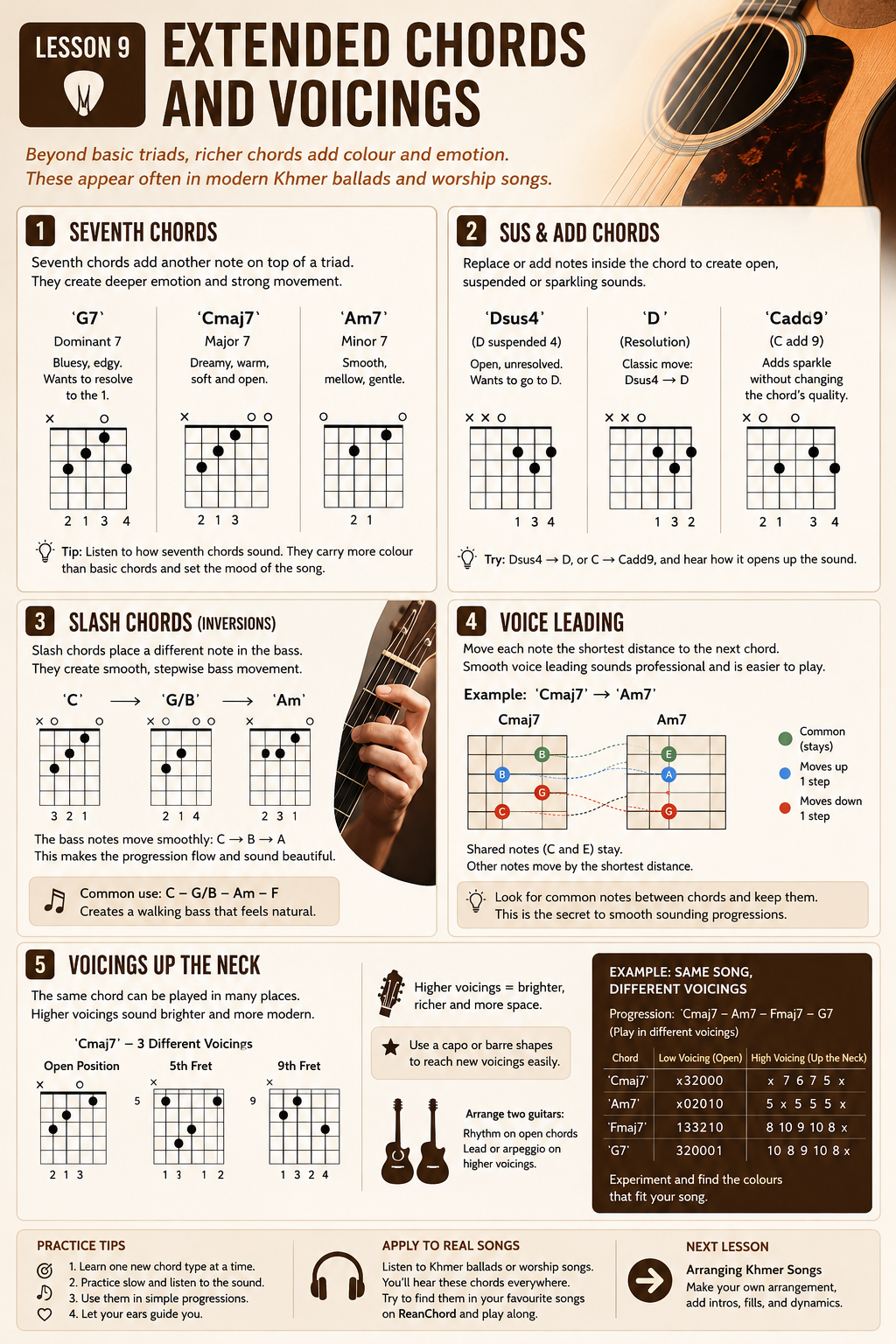
Beyond basic triads, richer chords add colour, softness, tension, and emotional depth. These sounds appear often in modern Khmer ballads, worship songs, acoustic pop, and many gentle fingerstyle arrangements.
Most beginner songs use simple triads such as , , , and . As your ear develops, you begin to hear richer chords and alternate voicings that add emotion and colour.
Chord-label rule: Every chord name in this lesson is marked like , , , , , or .
1. From Triads to Richer Chords
A basic triad has three notes.
For example:
- =
- =
- =
Extended chords build on top of those three notes by adding another scale tone, most commonly the 7th, or by replacing a note such as the 3rd.
This does not mean the original triad disappears. It means the chord gains a new flavour.
2. Seventh Chords
A seventh chord adds one more note above the triad.
Dominant Seventh:
A dominant seventh chord is built from a major triad plus a minor 7th.
Example:
=
This chord has tension. It strongly wants to resolve to the 1 chord.
In the key of , usually resolves to .
This is why feels active and directional. It is common in blues, folk, gospel, and worship music.
A simple example:
– –
The pulls the ear back home.
Major Seventh:
A major seventh chord is built from a major triad plus a major 7th.
Example:
=
This chord sounds soft, dreamy, warm, and reflective.
Example:
– – –
Minor Seventh:
A minor seventh chord is built from a minor triad plus a minor 7th.
Example:
=
It sounds mellow, smooth, and relaxed.
Try this progression:
– – –
The feels gentler than a plain .
3. Sus Chords
A suspended chord removes the 3rd and replaces it with another note.
This creates an open, unresolved feeling because the chord is no longer clearly major or minor.
sus4
A sus4 chord replaces the 3rd with the 4th.
Example:
=
One of the most classic movements on guitar is:
→
The note on the 4th scale degree resolves down to the major 3rd, creating a satisfying release.
sus2
A sus2 chord replaces the 3rd with the 2nd.
Example:
=
Try:
– –
or
– Gsus2 –
4. Add Chords
An add chord keeps the original triad and adds an extra note without turning the chord into a seventh chord.
A common example is .
This means:
- start with =
- add the 9th, which is the same note name as the 2nd,
So:
=
The result sounds bright, sparkling, and open.
Unlike Csus2, keeps the 3rd, so it still clearly sounds major.
Try:
– – –
This progression sounds familiar, rich, and contemporary.
5. Slash Chords and Inversions
A slash chord changes the bass note of a chord.
Example:
This means:
- play a chord
- put in the bass
Another example:
This means:
- play a chord
- put in the bass
These are also called inversions when the bass note comes from inside the chord.
Slash chords help create smoother bass lines.
Example:
– –
The bass notes move:
→ →
This stepwise motion sounds smooth and professional.
Another useful line is:
– –
The bass moves:
→ →
6. Voice Leading
Voice leading means moving each note of one chord to the nearest possible note in the next chord.
Good voice leading makes progressions sound smooth and musical.
It also makes playing easier because your fingers move less.
Shared Notes
Look for notes that stay the same between chords.
For example:
=
=
These two chords share and .
That means only one note really needs to change.
This is why to often feels natural and easy.
Shortest Movement
Try moving chord tones by the smallest distance possible.
Example:
to
=
=
They share and .
Only needs to move down to in another voicing or shift slightly in the arrangement.
7. Simple Voice-Leading Examples
Try these progressions and listen for smoothness:
Example 1
– – –
The bass moves down step by step, and the progression feels connected.
Example 2
– –
Only one note changes, but the effect is expressive.
Example 3
– –
The chord function stays similar, but the colour changes.
8. Voicings Up the Neck
A voicing is one specific way of playing a chord.
The same chord can be played in multiple places on the neck.
For example, can appear as:
- an open chord
- a barre-chord shape higher on the neck
- a smaller three- or four-note shape on the top strings
Higher voicings sound brighter and lighter. Lower voicings sound fuller and deeper.
This matters in arrangement.
Two-Guitar Arranging
If one guitarist plays open chords and the second guitarist plays higher voicings, the arrangement sounds wider and more interesting.
For example:
- Guitar 1 plays open , , ,
- Guitar 2 plays higher voicings of the same chords
9. Capo, Barre Chords, and Voicing Choice
A capo can also change the voicing character of a song.
Even if the chord function stays the same, using a capo moves the playable shapes higher, often producing a brighter and sweeter tone.
Barre chords help you choose voicings in different parts of the neck.
This gives you more control over:
- brightness
- bass weight
- note overlap
- smooth voice leading
10. Common Mistakes
Avoid these habits:
- using richer chords only because they look advanced
- replacing every simple chord with a complex one
- ignoring the bass note in slash chords
- moving fingers more than necessary
- forgetting to listen for shared notes
- treating
suschords as permanent when they often want resolution - confusing
add9withsus2 - playing every voicing in the same neck area
11. Practice Routine
Minutes 1–3
Play , then , then . Listen to the difference in colour.
Minutes 4–6
Play , then . Compare the sound.
Minutes 7–9
Practice → and → .
Minutes 10–12
Play – – slowly and listen to the bass line.
Minutes 13–15
Choose one simple progression such as – – – and replace one or two chords with richer versions like , , or .
Lesson Checklist
Before moving forward, make sure you can:
- explain what a seventh chord is
- describe , , and
- explain the difference between
sus2andsus4 - explain what means
- understand slash chords like and
- use bass movement to connect chords
- describe voice leading
- spot shared notes between chords
- explain what a voicing is
- understand why higher voicings sound brighter
Encouragement
Extended chords and alternate voicings help a simple progression feel more beautiful and expressive.
Start small. You do not need to change every chord in a song. Even one move like → , or one bass line like – – , can transform the sound.
Next Lesson
Arranging Khmer Songs
Next, you will learn how to choose a key, simplify or enrich chords, shape the intro and verse, support the melody, and build a complete guitar arrangement for Khmer songs.