
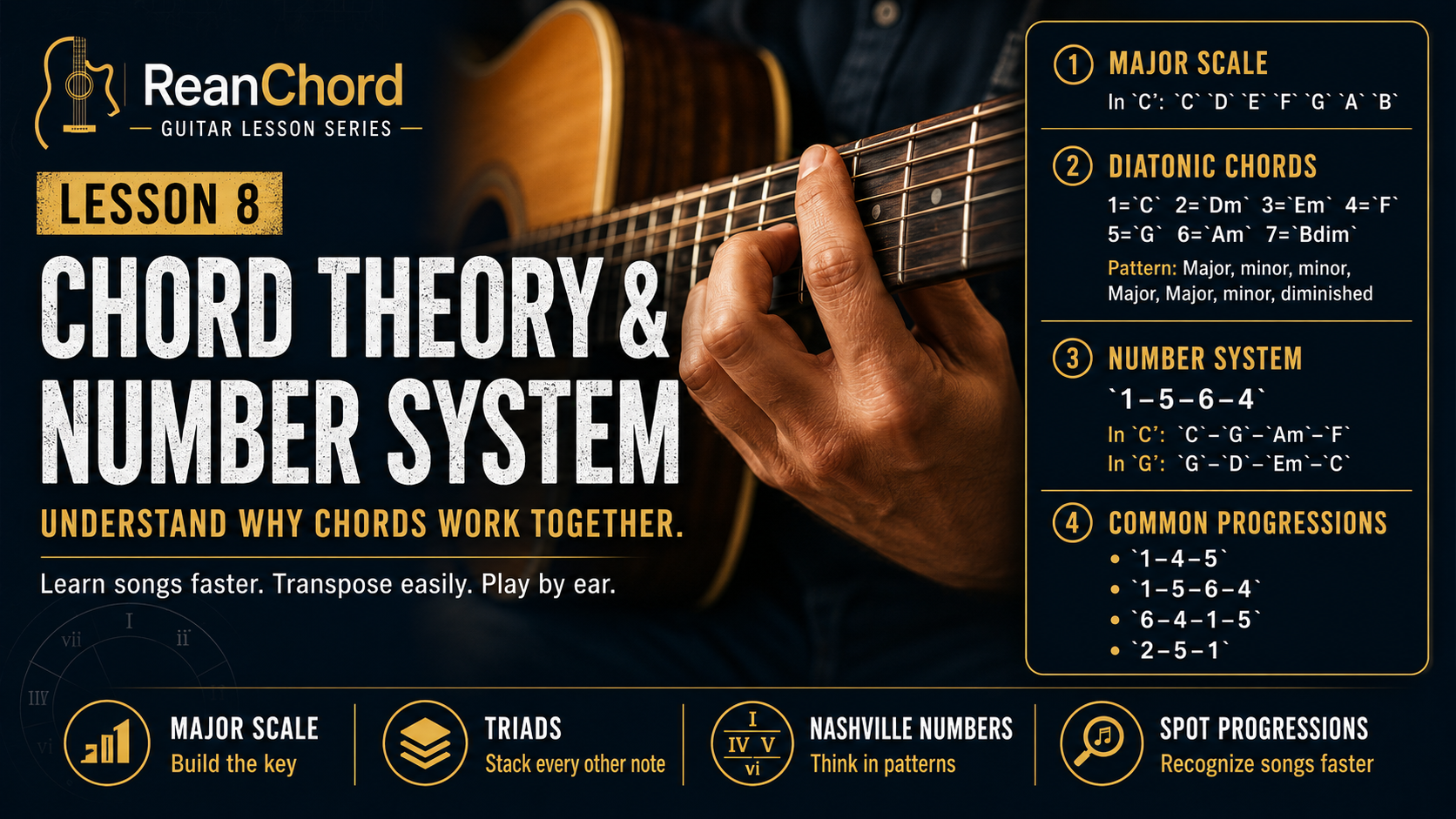
Advanced · Chord Theory & the Number System
Chord Theory and the Number System
Understanding why chords work together helps you learn songs faster, transpose easily, and begin playing by ear.
Instead of memorizing every song separately, you can learn the patterns behind the music.
Chord-label rule: Every chord name in this lesson is marked like , , , or
Bdim.
1. What Is a Musical Key?
A musical key is a group of notes and chords centered around one main note, called the tonic or 1 chord.
In C major, feels like home. Melodies and progressions often resolve to it.
2. The Major Scale
A major scale contains seven notes before repeating at the octave.
The C major scale is:
– – – – – –
Each note receives a scale-degree number:
1 =
2 =
3 =
4 =
5 =
6 =
7 =
These numbers describe melodies and chords without depending on one key.
3. The Major-Scale Formula
Every major scale follows the same pattern of whole steps and half steps.
The formula is:
Whole – Whole – Half – Whole – Whole – Whole – Half
Starting from :
to = whole step
to = whole step
to = half step
to = whole step
to = whole step
to = whole step
to = half step
4. What Is a Triad?
A triad is a three-note chord built by stacking every other note of a scale.
For example, begin on in the C major scale:
– skip – – skip –
The notes are:
– –
These notes form a C major chord.
5. Building Every Chord in C Major
Use the same method on each scale degree.
Chord 1
Start on :
– –
This creates C major.
Chord 2
Start on :
– –
This creates .
Chord 3
Start on :
– –
This creates .
Chord 4
Start on :
– –
This creates F major.
Chord 5
Start on :
– –
This creates G major.
Chord 6
Start on :
– –
This creates .
Chord 7
Start on :
– –
This creates Bdim, also written B°.
6. The Diatonic Chords in a Major Key
The seven natural chords of a major scale are called diatonic chords.
In C major, they are:
1 =
2 =
3 =
4 =
5 =
6 =
7 = Bdim
The chord-quality pattern is:
Major – minor – minor – Major – Major – minor – diminished
This pattern is the same in every major key.
7. The Same Pattern in G Major
The notes of G major are:
– – – – – –
The diatonic chords are:
1 =
2 =
3 =
4 =
5 =
6 =
7 = F#dim
The letters changed, but the chord-quality pattern stayed the same.
8. The Nashville Number System
The Nashville Number System names chords by position instead of letter.
For example, in C major:
– – –
becomes:
1 – 5 – 6 – 4
In G major, the same progression is:
– – –
It is still:
1 – 5 – 6 – 4
The musical movement stays similar because the chord functions are the same.
9. Why Numbers Help
Thinking in numbers helps you transpose, recognize patterns, play with others, learn by ear, and move progressions into any key.
10. Common Chord Progressions
1–4–5
This progression is common in folk, rock, and blues.
In C major:
– –
In G major:
– –
The 5 chord creates tension and often resolves back to the 1 chord.
1–5–6–4
This is one of the most common pop progressions.
In C major:
– – –
In G major:
– – –
In D major:
– – –
It works well in verses and choruses.
6–4–1–5
This progression often sounds emotional or reflective.
In C major:
– – –
In G major:
– – –
2–5–1
This progression is important in jazz and older pop.
In C major:
– –
In G major:
– –
11. Chord Function
Each chord has a function inside the key.
Tonic Function
The 1 chord feels stable and complete.
In C major, the tonic is .
Subdominant Function
The 4 chord moves the music away from home.
In C major, this is .
Dominant Function
The 5 chord creates tension and wants to return to the 1.
In C major, this is .
These functions help you hear where a progression is going.
12. Relative Major and Minor
Every major key has a relative minor using the same notes and chords.
The relative minor begins on scale degree 6.
In C major, chord 6 is .
Therefore:
C major and A minor are relative keys.
But they feel centered around different home chords.
Music centered on feels major; music centered on feels minor.
13. Applying the System on ReanChord
Open a song on ReanChord and follow these steps:
- Find the song’s key.
- Write the major scale for that key.
- Match each chord to its number.
- Look for repeated patterns.
- Compare the verse and chorus.
- Transpose the song and check that the number pattern stays the same.
Example in the key of :
– – –
Label it as:
1 – 5 – 6 – 4
If you transpose the song into , it becomes:
– – –
The number pattern remains 1–5–6–4.
14. Practice Exercise
Use the key of C major.
The scale is:
– – – – – –
Write the seven diatonic chords:
– – – – – – Bdim
Then play:
– – –
Label it:
1 – 4 – 5 – 1
Next, play:
– – –
Label it:
6 – 4 – 1 – 5
15. Common Mistakes
Avoid these habits:
- Calling every chord by its letter only
- Forgetting the key before assigning numbers
- Treating the
6chord as major in a major key - Ignoring the diminished
7chord - Assuming numbers always represent major chords
- Changing the number pattern while transposing
- Memorizing theory without playing the chords
- Expecting to recognize every progression immediately
Theory becomes useful when you play it.
Lesson Checklist
Before moving forward, make sure you can:
- explain what a musical key is
- name the notes in
C major - describe how a triad is built
- list the seven diatonic chords in
C major - remember the major-key chord-quality pattern
- explain the Nashville Number System
- recognize
1–4–5 - recognize
1–5–6–4 - recognize
6–4–1–5 - recognize
2–5–1 - identify tonic, subdominant, and dominant functions
- label chords by number on ReanChord
Encouragement
Chord theory does not replace creativity; it gives you a map for learning, transposing, recognizing patterns, and predicting what may come next.
Start by mastering one key, such as C major. Then apply the same number pattern to G major and D major.
Next Lesson
Extended Chords and Voicings
Next, you will learn how chords such as , , , , and add color, emotion, and movement to ordinary progressions.